

An electric spin scrubber is a battery-powered cleaning tool with a rotating brush head that replaces manual scrubbing on hard surfaces. Expect to pay $28–$60, charge it for 3–4 hours, get 70–110 minutes of real working time, and replace the brush heads every 4–6 months.
This page answers the questions people actually ask before and after buying one — battery life, surfaces to avoid, cleaning solutions, head replacement, waterproofing, and repairs. Each answer stands alone, so skip to whichever one you need.
- What it does: Spins a brush head at roughly 250–360 RPM so the motor does the scrubbing motion instead of your wrist.
- Battery life is the real differentiator. Consumer Reports found the spread runs from over an hour (HOTO, Casabella) down to about 10 minutes (Dremel Versa, Bell + Howell Scrubtastic) — a six-fold gap between named brands.
- Charging: 3–4 hours using a 5V adapter only. Higher-voltage fast chargers can damage the charging board.
- Safe surfaces: Ceramic and porcelain tile, grout, acrylic tubs, sinks, glass shower doors (sponge pad only), stovetops, car wheels.
- Avoid entirely: Carpet, upholstery, unsealed natural stone, painted finishes, and car paintwork with stiff bristles.
- Cleaning solution: Mild detergent works. Skip bleach and abrasive powders — they degrade bristles and plastic housings.
- Brush heads: Replace every 4–6 months; sponge and cloth pads every 3 months (HOTO guidance).
- Waterproofing caveat: IPX7 covers immersion, not pressurised jets. Rinse the head under a tap, keep spray off the body and charging port.
- Typical lifespan: 2–3 years, limited by the battery rather than the motor or brushes.
- Consumer Reports testing lead Dan Kahl states the biggest difference between a good power scrubber and a subpar one is battery life. Models ranged from over an hour down to roughly 10 minutes before dying.
- Critically, CR reported that in cleaning evaluations all the models cleaned pretty much the same — which is why they stopped weighting cleaning performance in their ratings.
- HOTO Electric Spin Scrubber: 4,000mAh lithium battery, approximately 3 hours to full charge, up to 110 minutes of runtime, IPX7 main body, one-year warranty (HOTO via Best Buy Q&A and HOTO support).
- Charging input: Bomves recommends a 5V/2A adapter and specifies the USB charging port must be dry before charging.
- Brush head replacement: every 4–6 months, with sponge and cloth pads every 3 months under normal weekly use (HOTO Tools).
- Speed range: Typical dual-speed units run 250 RPM low / 360 RPM high; older corded designs sat around 300 RPM.
What is an electric spin scrubber and how does it work?
An electric spin scrubber is a handheld cleaning tool where a small motor rotates a detachable brush head, typically at 250–360 RPM, so the tool performs the scrubbing motion instead of your arm.
The mechanics are simple. A rechargeable battery drives a geared motor, the motor turns a drive shaft, and the shaft locks into a brush head. You guide the tool across the surface and apply light pressure — the rotation does the work that your wrist used to do.
Most models include an extension pole reaching 100–112cm, which is the feature that genuinely changes bathroom cleaning. Shower ceilings, the back of a tub and floor grout all become reachable without kneeling or stretching. For the full mechanical breakdown, see our guide on what an electric spin scrubber is and how it works.
How long does an electric spin scrubber battery last?
Expect 70–110 minutes of working time from a full charge on a decent model, and 2–3 years before the battery itself needs replacing. Charging takes 3–4 hours.
Here is the number that should shape your buying decision. Consumer Reports found the runtime spread across tested models ran from over an hour down to about ten minutes — the HOTO and Casabella units at the top, the Dremel Versa and Bell + Howell Scrubtastic at the bottom.
Also worth knowing: advertised runtime is measured with no load. Pressing a brush against tile draws several times the current of spinning in open air, so real working time typically lands 15–20% below the number on the box.
| Question | Short answer | The detail that matters |
|---|---|---|
| How long to charge? | 3–4 hours | HOTO reaches full in about 3 hours for up to 110 min runtime |
| What adapter? | 5V only | Bomves specifies 5V/2A; higher-voltage fast chargers risk the board |
| Where's the port? | Base of the handle | Remove the extension pole first, then open the sealed tail cover |
| Can I use it while charging? | No | Most models lock out during charging by design — not a fault |
| How do I know it's full? | Varies by brand | Many show no light when full; Bomves shows all 5 lights on |
| When is the battery finished? | Under 15 min runtime | Charge fully, run with no load, and time it to confirm |
Our full walkthrough on how to charge an electric spin scrubber covers port locations by model, indicator patterns, and the battery habits that add years to the pack.
Every product listing shouts about RPM, "8-IN-1" head counts and motor strength. Consumer Reports tested how well power scrubbers handled dried mustard, honey and oil — and found that all the models cleaned pretty much the same. They subsequently reduced the weight of cleaning performance in their ratings because it stopped discriminating between products.
So the marketing is measuring the wrong thing. What actually varies is battery life, weight, grip comfort and extension pole length — the boring specs nobody advertises. If two scrubbers sit in front of you and one claims 360 RPM while the other claims 300, that difference is close to meaningless. If one runs 90 minutes and the other runs 15, that difference decides whether you finish the bathroom.
Practical takeaway: ignore RPM entirely. Buy on runtime, weight and pole reach.
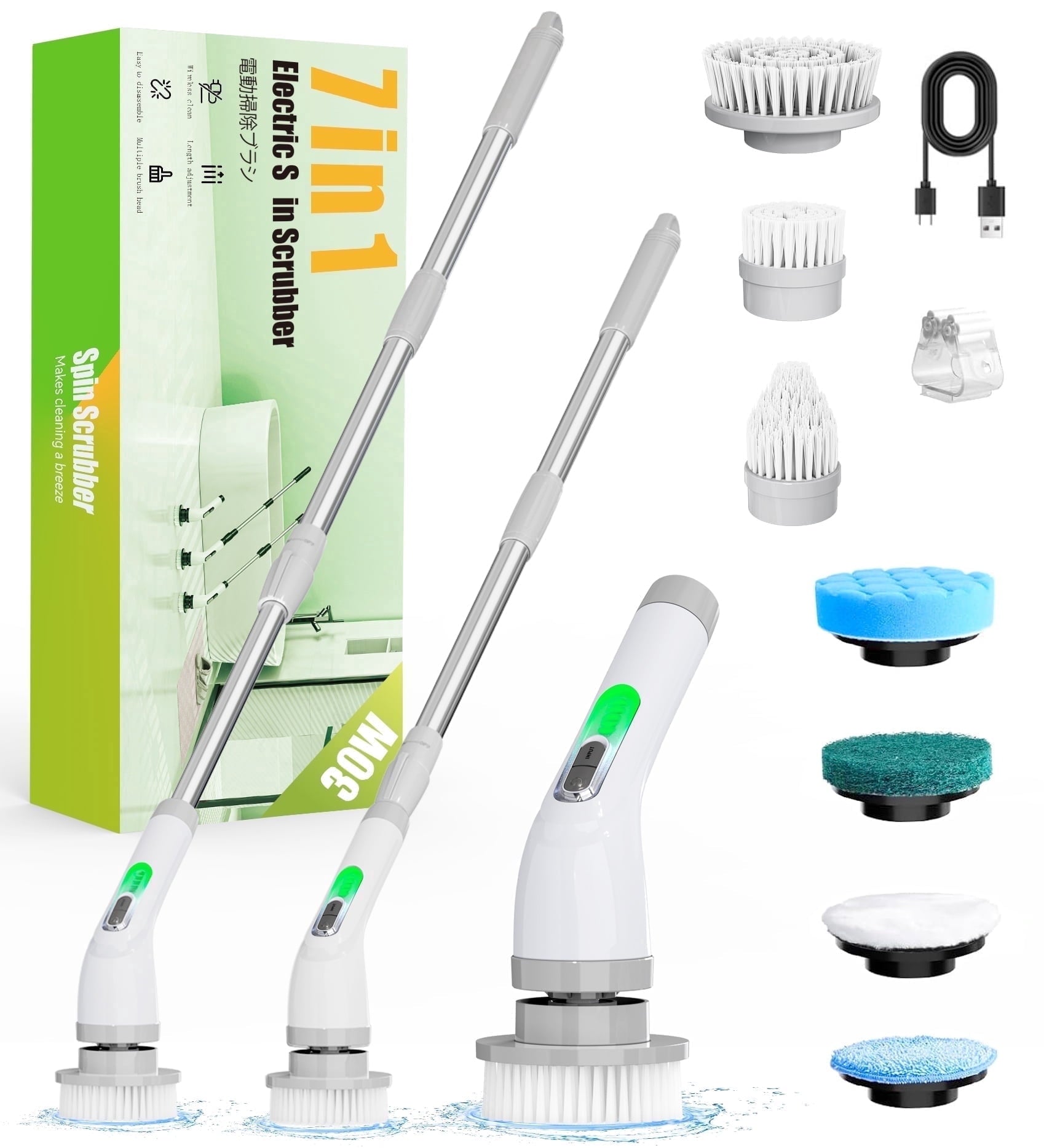
Electric Spin Scrubber — Cordless Power Cleaning Brush
A rechargeable battery sized to finish a full bathroom in one session, with interchangeable heads for tile, grout, corners and fixtures.
What surfaces can you use an electric spin scrubber on?
Use it on hard, non-porous surfaces: ceramic and porcelain tile, grout, acrylic tubs, sinks, glass, stovetops, window tracks and car wheels. Avoid carpet, upholstery, unsealed stone and painted finishes entirely.
The rule underneath all of this is head selection, not room. A flat brush belongs on any large smooth plane; a pointed corner brush belongs anywhere two planes meet. Getting that wrong causes most "my scrubber doesn't work well" complaints.
| Surface | Safe? | Which head | Why |
|---|---|---|---|
| Ceramic / porcelain tile | Yes | Large flat brush | Hard glazed surface; ideal use case |
| Grout lines | Yes | Pointed corner brush | Flat discs bridge the channel and never reach in |
| Acrylic bathtub | Yes | Dome or soft flat brush | Stiff bristles can leave fine scratches on acrylic |
| Glass shower doors | Yes | Sponge or cloth pad only | Bristle brushes can scratch glass permanently |
| Stovetops and greasy walls | Yes | Scouring head | Needs abrasion; use mild degreaser, not bleach |
| Car wheels | Yes | Stiff bristle brush | Keep stiff heads away from paintwork entirely |
| Marble, travertine, unsealed stone | No | — | Porous and soft; bristles etch and dull the finish |
| Carpet and upholstery | No | — | Rotation snags and tears fibres |
| Painted or varnished finishes | No | — | Abrasion strips the coating |
Best for: Electric spin scrubbers suit households with tiled bathrooms, visible grout, textured tubs, or anyone who finds kneeling and repetitive scrubbing physically difficult. They suit car owners cleaning wheels and trim. They do not suit homes dominated by natural stone, wood or painted surfaces, where a microfibre cloth remains the correct tool.
What cleaning solution should you use with a spin scrubber?
Use a mild detergent or your usual bathroom cleaner. Avoid bleach and abrasive powders, which degrade nylon bristles and can damage the plastic housing over time.
HOTO's guidance is that the scrubber works without any cleaning agent at all, though a preferred cleaner improves results on tougher stains — and that you should rinse with water after use to keep the machine in good condition. That final instruction matters more than people realise, because cleaner residue left in bristle tufts hardens and stiffens them.
Practical guidance by problem:
- Soap scum: A standard bathroom spray plus a flat brush. Let it dwell two minutes before scrubbing.
- Grout staining: Baking soda paste with a corner brush. Works better than liquid cleaners because it stays in the channel.
- Hard water scale in toilets: HOTO notes the scrubber removes hard water stains effectively but should be paired with a descaling detergent rather than used dry.
- Kitchen grease: Warm water and dish soap with a scouring head. Degreaser only if needed.
- Never: Bleach, scouring powder, or anything abrasive enough to feel gritty between your fingers.
Our guide on how to use an electric spin scrubber covers dwell times, angles and the pressure technique that gets better results with less bristle wear.
How often do you replace spin scrubber brush heads?
Replace brush heads every 4–6 months and sponge or cloth pads every 3 months under normal weekly use, according to HOTO's own guidance. Heavy grout work shortens that to 8–10 weeks.
Treat those figures as a ceiling rather than a schedule. The reliable test is physical: press your thumb into the outer ring of bristles, hold three seconds, and release. Healthy bristles snap upright instantly. Worn bristles stay flattened or drift back slowly, which means the nylon has lost its elastic memory and no amount of pressure will restore the scrubbing action.
Two related guides cover this in depth: how to replace an electric spin scrubber brush walks through connector types and fitting, while how to remove a brush from an electric spin scrubber covers the grip technique that frees stuck heads.
Detach the brush head after every clean, not just when swapping it. A damp head left locked on the shaft traps water in the joint where there is no airflow, and that single condition causes both the seized collars people fight with months later and the mildew smell they mistake for worn bristles. Rinse, remove, shake, wipe the shaft dry, store the head bristles-up. Thirty seconds, and heads last roughly twice as long.
Are electric spin scrubbers actually waterproof?
Most quality models rate IPX7 on the main body, which covers immersion in still water — but that does not automatically mean they survive pressurised water jets, and the extension pole and brush head usually are not waterproof at all.
This is the most widely misunderstood spec in the category. Under IEC 60529, immersion protection (IPX7) and jet protection (IPX5/IPX6) are separate tests, and a device only covers both if it carries a dual code such as IP66/IP67. Static water pressure squeezes a seal evenly; a directional jet can lift a gasket lip and push water straight past it.
HOTO's manual is explicit that while the main body reaches IPX7, the telescopic rod and brush head contain no electronics and are not waterproof, the USB-C waterproof plug must be tightened during use, and any water found in the charging port must be wiped dry before charging.
The practical rule: rinse the brush head under a tap with the body angled away, keep spray off the charging area, and never treat an IP number as permission to blast the tool clean under a shower head.
Electric Spin Scrubber — Cordless Power Cleaning Brush
A sealed charging cover and interchangeable heads for tile, grout, corners and fixtures — designed for bathrooms rather than tolerated in them.
What problems do spin scrubber owners run into most?
The five recurring complaints are motors that stall under pressure, batteries dying within a year, wobble when the extension pole is fitted, brush heads that will not come off, and units that stop mid-clean.
Reading through retailer Q&A threads, one comment captures the most common frustration almost perfectly: an owner noted the tool was wobbly with the extension pole attached, and that they could not press hard on the brush without it stopping. Both observations are correct — and both are fixable or avoidable.
| Problem | Real cause | Solution |
|---|---|---|
| Motor stops when you press hard | Overload protection tripping — a designed safety feature | Lift off, wait 30 seconds, press power once. Guide the tool rather than leaning on it |
| Wobble with the extension pole | Longer lever arm amplifies any play in the joint | Use the pole only for genuine reach; work handheld for detail. Check the pole lock is fully seated |
| Hums but the brush won't turn | Hair wrapped around the drive shaft | Power off, remove the head, cut the wrap away with scissors |
| Battery dead within a year | Small cell, or repeatedly run flat and stored empty | Top up after each clean; check warranty — HOTO covers one year |
| Brush head seized on the shaft | Limescale bonded inside the collar | Invert, soak just the head in warm soapy water 5–10 min, retry |
| Won't charge | Moisture in the port | Dry it 30+ minutes before plugging in anything |
For symptom-by-symptom diagnosis, our guide on why an electric spin scrubber stops working matches each fault to its fix, and how to unlock an electric spin scrubber covers seized mechanisms and safety locks.
Is an electric spin scrubber worth buying?
Yes, for anyone with tiled bathrooms who cleans weekly — provided you buy in the $28–$60 range and prioritise battery life. It is not worth buying for occasional light cleaning or homes dominated by stone and wood.
Pros
- Removes the repetitive wrist motion entirely
- Extension pole reaches shower ceilings and floor grout without kneeling
- Genuinely faster on soap scum and tub rings
- One tool covers bathroom, kitchen and car wheels
- Interchangeable heads suit different textures
Cons
- Battery limits the tool's life to roughly 2–3 years
- Brush heads are a recurring cost every 4–6 months
- Stalls if you press hard — a real adjustment for some
- Wobbles noticeably with the extension pole fitted
- Useless on carpet, stone and painted surfaces
For a model-by-model comparison including runtime, torque and parts availability, see our Best Electric Spin Scrubber guide for 2026, or our breakdown of where to buy an electric spin scrubber if you already know what you want.
More electric spin scrubber questions answered
Can you use an electric spin scrubber on glass shower doors?
Yes, but only with the sponge or cloth pad attachment. Standard nylon bristle brushes are too harsh for glass and can leave permanent fine scratches that catch the light afterwards. Fit the softest head available, use a standard glass or bathroom cleaner, and let the rotation do the work without pressing. The same rule applies to mirrors and polished chrome fixtures.
Do electric spin scrubbers work on grout?
Yes, and grout is where they outperform hand scrubbing most dramatically — but only with a pointed corner brush. A flat disc brush physically bridges the grout channel and never reaches into it, which is why people conclude the tool "doesn't work" on grout. Pair the corner brush with a baking soda paste, which stays in the channel better than a liquid cleaner. Expect a corner brush to wear out in 2–3 months with regular grout work.
How long does an electric spin scrubber last overall?
Two to three years for most mid-range models, and the battery is almost always what ends it rather than the motor. Lithium cells lose meaningful capacity after a few hundred charge cycles. Once a full charge no longer finishes a bathroom, replacing the unit usually costs less per year than nursing an old one. Brush heads are consumables throughout, replaced every 4–6 months.
Can you replace the battery in an electric spin scrubber?
Sometimes, depending on the design. Models with a removable battery pack are straightforward and a replacement typically costs $15–$30. Sealed-body units are not user-serviceable, and opening them voids the warranty while rarely succeeding. Check your warranty first — HOTO covers one year and will inspect the product if battery life shortens significantly within that period.
Is an electric spin scrubber better than a drill brush attachment?
For bathrooms, yes. Drill attachments cost $10–$20 and deliver more torque, but a drill is heavy, awkward to hold overhead, and most drills are not water-resistant. A purpose-built spin scrubber is lighter, safer around water, and its extension pole reaches shower ceilings without you holding a power tool above your head. Choose the drill brush if you already own a cordless drill and only clean occasionally.
Why does my spin scrubber stop when I press it against the surface?
Overload protection is cutting power to protect the motor from a locked-rotor condition. Lift the tool off completely, wait about 30 seconds, then press the power button once to reset it. The underlying cause is pressing too hard — these tools are designed so the rotation does the work while you guide them. If it trips repeatedly on the same job, fit a fresh brush head, because worn bristles make you press harder without noticing.
Can you put spin scrubber brush heads in the dishwasher?
No. Dishwasher temperatures regularly exceed 60°C, and sustained heat softens the adhesive holding bristle tufts in the base plate. The drying cycle can also warp the plastic collar enough that the head no longer seats squarely on the shaft, leaving you with a clean head that wobbles when it spins. Rinse under warm running water instead, working the bristles with your fingers, then dry bristles-up.
What comes in the box with an electric spin scrubber?
Typically the handheld body, an extension pole, three to eight brush heads and a USB charging cable. Note that many units ship the cable but no wall adapter, which surprises buyers — you need a basic 5V block, and your old phone charger works. Head counts vary wildly, but most households regularly use only three: a flat brush, a corner brush and a sponge pad.
What's the bottom line?
Buy on battery life, match the head to the surface texture, and treat brush heads as consumables. Those three principles resolve most questions people have about these tools.
The lab data says cleaning performance barely varies between models, so the marketing numbers on the box — RPM, head count, motor claims — tell you almost nothing useful. Runtime, weight and pole reach tell you everything.
After that, maintenance is the whole game: rinse the head, detach it, dry the shaft, keep water out of the charging port, and use a 5V adapter. Do that consistently and a mid-range scrubber comfortably reaches the end of its battery's natural life rather than dying early from neglect.
Electric Spin Scrubber — Cordless Power Cleaning Brush
Cordless, lightweight enough for overhead work, and effective on tile, grout, sinks, tubs and kitchen surfaces from the first use.
- Best Electric Spin Scrubber 2026: I Cleaned My Entire Bathroom in 8 Minutes — five models tested on runtime, torque and grout performance.
- What Is an Electric Spin Scrubber and How Does It Work? — the mechanics behind rotation, torque and head design.
- How to Use an Electric Spin Scrubber: Full Guide — pressure, angles and cleaning solutions.
- How to Charge an Electric Spin Scrubber — port locations, the 5V rule and battery care.
- How to Replace an Electric Spin Scrubber Brush in Under 60 Seconds — connector types and the bristle wear test.
- How to Remove a Brush from an Electric Spin Scrubber — the grip technique that frees stuck heads.
- Why Is My Electric Spin Scrubber Not Working? — symptom-by-symptom diagnosis.
- How to Unlock an Electric Spin Scrubber — safety locks and seized mechanisms.
- Where to Buy an Electric Spin Scrubber in 2026 — retailers compared on returns, warranty and parts.


