

If you've ever spent twenty minutes on your knees scrubbing bathroom grout only to see it still look grey and grimy, you already understand why so many people are asking: what is an electric spin scrubber, and can it actually fix this problem? The short answer is yes—and then some. An electric spin scrubber is a motorized cleaning tool that replaces the back-and-forth motion of a manual brush with a continuous, high-speed rotation. The result is a much deeper clean in a fraction of the time, and without the wrist fatigue that comes with traditional scrubbing.
Over the last few years, these gadgets have quietly become one of the most talked-about home cleaning tools around. You'll find them recommended in cleaning forums, featured in influencer "cleaning day" videos, and reviewed on thousands of home-goods pages. But not every buyer knows exactly what they're getting—or how to use one correctly. This guide covers everything from how the motor works to which brush head tackles which surface, so you can make a genuinely informed decision.
An electric spin scrubber is a cordless, battery-powered cleaning device with a rotating brush head driven by an electric motor. It spins at high speed to scrub tiles, grout, shower walls, floors, and kitchen surfaces far more effectively than a hand brush—without requiring significant physical effort. Most models include multiple brush attachments and an extendable handle for hard-to-reach areas.
What Is an Electric Spin Scrubber?
At its core, an electric spin scrubber is a power-assisted cleaning brush. Think of it as the cleaning equivalent of an electric toothbrush: instead of manually moving the bristles back and forth, a small motor inside the handle does it for you—automatically, quickly, and consistently. The brush head rotates in a circular motion, producing hundreds of scrubbing strokes per minute that would be physically impossible to replicate by hand.
Where it really sets itself apart from a traditional bathroom cleaning brush is in consistency. Human scrubbing is naturally uneven—you apply more pressure in some spots, get tired after a minute, and miss corners. The spinning brush head of a power spin scrubber maintains the same speed and pressure throughout, which leads to more uniform results. It's also designed to be ergonomically comfortable, with a handle that keeps your wrist in a neutral position rather than the awkward angles a manual brush often forces.
"The right cleaning tool doesn't just save time—it makes difficult chores feel effortless."
These tools come in corded and battery-powered versions, though the vast majority of buyers today opt for a cordless electric spin scrubber. The freedom to move around a bathroom or kitchen without wrestling with a power cord makes a tangible difference when you're cleaning in tight spaces. Rechargeable models are the most popular, typically using a USB-C or dedicated charging cable.
How Does an Electric Spin Scrubber Work?
The mechanism inside an electric cleaning brush is simpler than you might expect. A rechargeable lithium-ion battery powers a small electric motor housed in the handle. When you press the power button, the motor converts electrical energy into rotational force and transfers it down a drive shaft to the brush head. The head then spins at speeds typically ranging from 300 to 500 RPM depending on the model—fast enough to agitate and loosen soap scum, mildew, and mineral deposits on contact.
Quick Fact: Most electric spin scrubbers spin at 300–500 RPM. At 400 RPM, the brush head completes more than 6 full rotations every second—far more scrubbing power than a human hand can produce.
Most models feature a simple one-button or two-speed control. Some offer a turbo mode for stubborn stains. The brush heads attach via a quick-connect mechanism—usually a push-and-click system—so you can swap between a small detail brush, a flat scrubbing pad, or a corner brush in seconds. This flexibility is what makes the electric scrubber for tiles equally useful in the bathroom, kitchen, and even outdoors.
The handle on most models is also extendable. A telescoping extension pole lets you reach high shower walls, ceiling tiles, or low floor corners without kneeling or stretching. Many users say this feature alone is worth the purchase—cleaning behind the toilet or scrubbing a high-mounted shower shelf without straining your back is a genuine quality-of-life improvement.
On the water resistance front: most quality spin scrubbers are rated IPX5 or higher, meaning they can be used safely in wet environments. You don't need to worry about using one in a running shower or near a sink. The charging port is usually sealed when not in use to prevent moisture damage.
Main Parts of an Electric Spin Scrubber
Understanding what each component does helps you use the tool more effectively—and know when something needs attention.
Motor
Located inside the main handle unit, the motor is the heart of the device. A more powerful motor (measured in watts) generally means higher torque, which matters when you're scrubbing heavily soiled grout or textured tile surfaces.
Handle and Grip
Designed for single-handed or two-handed use, the handle is usually made of a rubberized material for a non-slip grip in wet conditions. The angle is ergonomically designed to reduce wrist strain during extended cleaning sessions.
Rechargeable Battery
Most cordless models use a built-in lithium-ion battery with a run time of 60 to 120 minutes per charge. Charging takes roughly 2–4 hours via USB or dedicated charger. Battery performance is one of the most important factors separating good scrubbers from great ones.
Brush Heads
The interchangeable brush attachments are what give the tool its versatility. A standard kit typically includes a large flat brush, a small round detail brush, and sometimes a corner brush or sponge pad. Higher-end kits can include six or more attachments.
Charging Port
Usually located on the lower end of the handle with a protective cap. Modern models increasingly use USB-C for convenience, so you can charge with the same cable as your phone.
Extension Pole
A telescoping shaft that connects between the handle and the brush head, typically extending from around 20 inches to 47 inches. This is the feature that makes the tool genuinely useful for floors (without kneeling) and high surfaces (without a step stool). It transforms the tool from a simple bathroom scrubber into a full-featured cleaning brush with extension handle for the whole home.
Different Brush Heads and Their Uses
The brush head you choose matters more than most beginners realize. Using the wrong attachment on a delicate surface can cause scratches; using too soft a brush on heavy mildew won't make a dent. Here's a breakdown of what each type does best.
| Brush Head | Best For | Recommended Surface |
|---|---|---|
| Large Round Flat Brush | General scrubbing, large areas | Floor tiles, bathtub base, countertops |
| Small Round Detail Brush | Tight spaces, faucets, corners | Grout lines, sink drains, faucet bases |
| Corner / Angled Brush | Reaching into 90° corners | Shower corners, toilet base, cabinet edges |
| Flat Sponge Pad | Gentle wiping, glass surfaces | Shower glass, mirrors, car paint |
| Stiff Bristle Brush | Heavy-duty grime and mildew | Outdoor patio, concrete, BBQ grates |
| Soft Bristle Brush | Delicate finishes, light cleaning | Enamel bathtubs, painted tiles, wood |
When cleaning grout lines, pair the small round detail brush with a spray of diluted white vinegar or a commercial grout cleaner. Let it sit for two minutes before running the scrubber. The combination of chemical action and mechanical spinning makes even deeply stained grout look dramatically better.
Benefits of Using an Electric Spin Scrubber
"Consistent cleaning is easier when the equipment does most of the hard work."
The most obvious benefit is time. A bathroom that takes 30 minutes to scrub manually can often be cleaned in 10–12 minutes with a power spin scrubber. The motor doesn't get tired, and it doesn't slow down mid-job. But time savings are just the beginning.
Physical effort: Scrubbing tiles by hand is genuinely hard work—it strains your shoulders, wrists, and knees. An electric scrubber eliminates that entirely. People with arthritis, back problems, or limited hand strength often find it transformative. You're essentially acting as the tool's steering mechanism while the motor does the actual labor.
Cleaning results: The continuous circular motion agitates cleaning products more effectively than back-and-forth scrubbing. Soap scum, hard water deposits, and mildew all respond better to rotational friction. Most users report that their tiles and grout look cleaner than they've been in years after their first proper session.
Versatility: A good rechargeable spin scrubber with multiple attachments functions as a bathroom cleaning brush, a kitchen cleaning brush, a floor cleaning brush, a shower scrubber, and even a car-wheel cleaner—all in one device. You'd need a whole drawer of specialized brushes to replicate that range manually.
Reach: The extension handle changes the entire geometry of cleaning. You can scrub the floor without crouching, clean the top of the shower wall without a step stool, and reach under shelving without contorting yourself. For anyone cleaning a large bathroom or a kitchen with high backsplash, this matters enormously.
Where Can You Use an Electric Spin Scrubber?
One of the strongest arguments for investing in an Electric Spin Scrubber is how many surfaces it can handle. This isn't a single-use bathroom gadget—it's a general-purpose cleaning tool with a wide range of applications.
In the bathroom, it excels at shower walls, bathtub surrounds, toilet exteriors, and floor tiles. It's especially effective as a grout cleaning brush—the small detail attachment fits precisely into grout channels and removes buildup that even strong cleaners struggle to dislodge by hand. If you've got a glass shower door with soap scum, the sponge pad attachment handles that without the risk of scratching.
In the kitchen, the spin scrubber tackles countertops, sink basins, stovetop surrounds, and the grout between backsplash tiles. It's also great for cleaning the rubber seal around a refrigerator door—somewhere most people avoid because it's awkward to scrub by hand. You can even use it on oven doors if you're careful to use the gentler attachment.
For floors, especially tiled bathroom or kitchen floors, the flat brush with the extension handle means you can mop-scrub the surface while standing upright. This is far more effective at lifting embedded grime than a standard mop, which just pushes dirty water around.
Beyond the home: car wheels, outdoor patio furniture, BBQ grills, garden pots, and even boat fiberglass all respond well to a stiff-bristle attachment. Some users keep a dedicated "outdoor" brush head specifically for this purpose.
Is an Electric Spin Scrubber Worth Buying?
Let's be honest about this, because a fair answer helps more than a purely promotional one. For most households, yes—especially if you have tiled bathrooms, a shower, or a kitchen with grout lines. The comparison below makes the differences clear.
| Feature | Electric Spin Scrubber | Manual Scrub Brush |
|---|---|---|
| Scrubbing speed | 300–500 RPM continuous | Variable, slows with fatigue |
| Physical effort | Minimal — motor does the work | High — all effort from user |
| Cleaning effectiveness | Excellent on grout & tile | Moderate; depends on strength |
| Reach | Up to 47" with extension pole | Limited to arm's length |
| Versatility | Multiple attachments, many surfaces | Limited to one brush type |
| Cost | $40–$80 (one-time) | $5–$15 |
| Maintenance | Charge battery, rinse heads | Rinse and replace when worn |
| Time to clean bathroom | 10–15 minutes | 25–40 minutes |
The honest limitation: an electric spin scrubber isn't suited for every task. It's not meant for upholstered furniture, hardwood floors, or any surface that can't handle moisture. And like any rechargeable device, you need to remember to charge it—running out of battery halfway through cleaning a grimy bathtub is frustrating. The motor is also not silent; it produces a moderate hum that some people find annoying in quiet apartments.
But on balance, for anyone who finds bathroom or kitchen cleaning genuinely tiring or who struggles with hard-to-remove buildup, a cordless cleaning brush at the $50–$80 price point delivers real, measurable value. If you want help comparing different models before you buy, our guide to the best electric spin scrubber walks through the top options side by side.
Tips for Getting the Best Results
Getting good results from a spin scrubber for bathroom cleaning isn't complicated, but a few simple practices make a significant difference.
Pre-spray before scrubbing. Apply your cleaner—tile spray, bathroom foam, or diluted bleach—two to three minutes before you start scrubbing. Letting the chemical work first means the scrubber needs less physical passes to get results.
Use slow, overlapping passes. Resist the urge to rush. Move the scrubber slowly across the surface so the spinning brush has time to agitate each section properly. Overlapping your passes slightly ensures you don't miss patches.
Work top to bottom, especially in showers. Start at the highest wall tiles and work down. Loosened grime and cleaning product will drip downward, so you'll end up scrubbing lower sections only once rather than recleaning them.
For maintenance: rinse the brush heads under running water after every use. Soap and cleaner residue left in the bristles shortens their lifespan. Once a month, soak the heads in warm water with a little white vinegar to remove any mineral buildup. Store the scrubber in a dry place with the brush head detached so airflow can dry both parts completely.
Common Mistakes to Avoid
Most beginner errors with an electric scrubber for tiles come down to impatience or using the wrong settings. Here are the ones that come up most often—and how to sidestep them.
Pressing too hard. The motor generates the scrubbing force—you don't need to push down firmly. Excessive pressure can actually slow the rotation and reduce effectiveness. A light, guiding touch is all that's needed. Let the RPMs do the work.
Using the wrong brush on delicate surfaces. Stiff-bristle attachments are designed for outdoor concrete and heavily soiled grout. Using one on enamel, acrylic, or polished chrome will leave scratches. Always check the surface before choosing your brush head. When in doubt, start with the softer option.
Neglecting to rinse afterward. Cleaning product that dries on tiles leaves a residue that looks dull and sticky. Always follow scrubbing with a thorough rinse—either with the shower, a bucket, or a damp cloth—to remove all foam and loosened debris.
Ignoring the battery indicator. Many people don't notice the battery dying until the scrubber is mid-job. Get in the habit of charging after every cleaning session. That way, it's always ready to go when you need it, and you're never left with a half-cleaned tile floor.
Skipping the extension pole for floor cleaning. People often skip assembling the extension pole to save a few seconds of setup, then end up on their knees scrubbing the floor by hand. The extension pole takes thirty seconds to attach and makes floor cleaning dramatically easier. Use it.
Our Recommended Product
If you're ready to experience the difference a quality cordless scrubber makes, the Rechargeable Electric Spin Scrubber from Elite Essentials Store is a well-rounded choice for most households. It covers everything discussed in this article—multiple brush heads, an extendable pole, IPX-rated water resistance, and a rechargeable battery with solid run time.
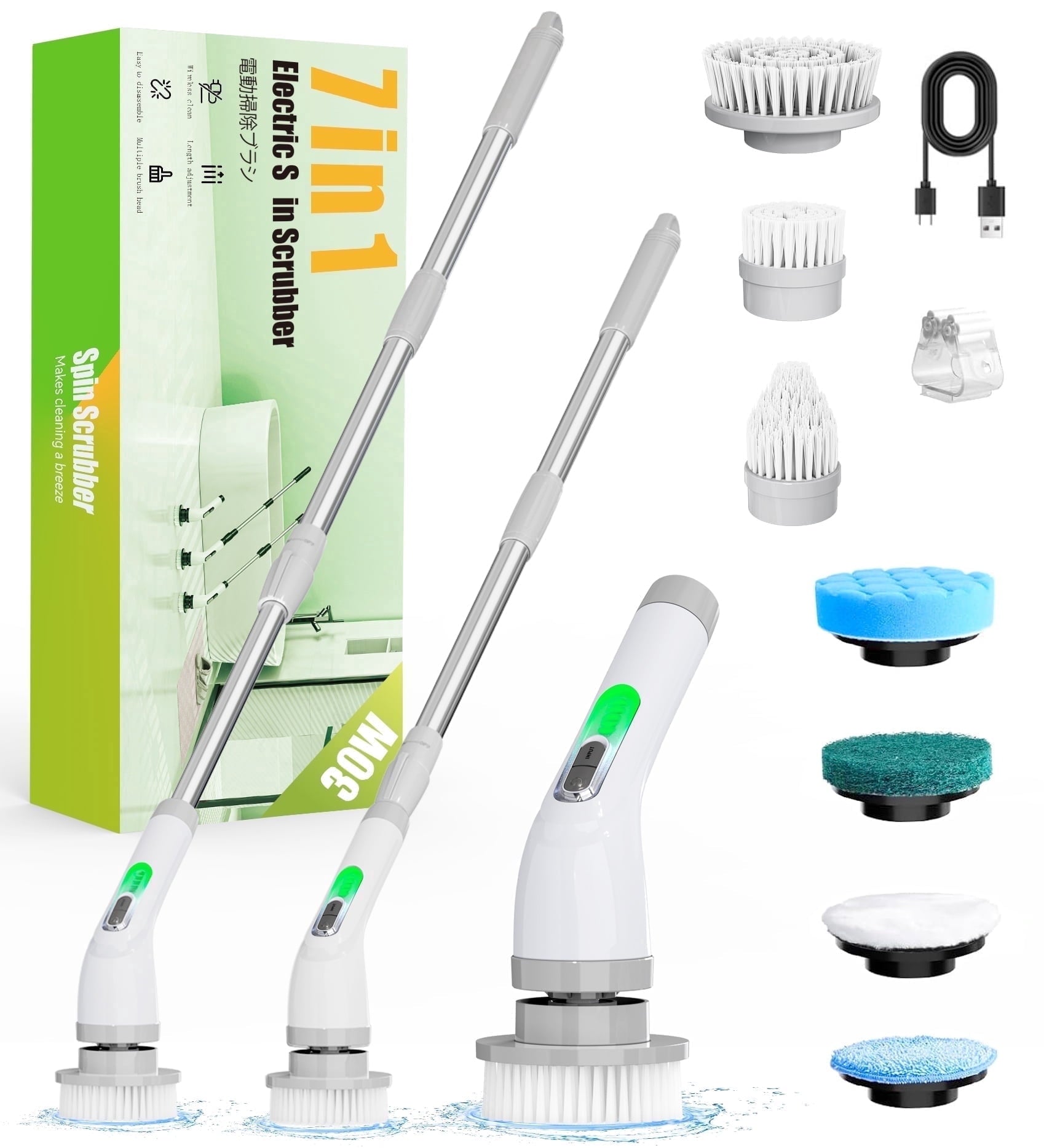
Electric Spin Scrubber – Cordless Power Cleaning Brush
Power through bathroom, kitchen, tile, grout, and floor cleaning with a cordless rechargeable scrubber designed to reduce scrubbing effort and deliver consistently better results than manual brushing.
This scrubber is particularly well-suited for people who clean their bathrooms weekly and want to maintain a high standard without spending significant time or energy. The included brush heads cover the most common household cleaning scenarios—tile walls, grout lines, floor corners, and glass surfaces—making it a genuinely versatile home cleaning tool rather than a single-purpose gadget.
It's also a strong choice as a gift for anyone setting up a new home or apartment. If you'd like to compare it against other models before buying, our detailed guide to the best electric spin scrubbers walks through the features and trade-offs across a range of price points.
Frequently Asked Questions
What is an electric spin scrubber?
An electric spin scrubber is a motorized cleaning tool with a rotating brush head powered by a rechargeable battery. It spins at several hundred rotations per minute to agitate and remove grime, soap scum, mildew, and mineral deposits from a wide range of surfaces—tiles, grout, glass, countertops, and more. It comes with interchangeable brush attachments and usually includes an extension handle for cleaning high or low areas without straining.
How does an electric spin scrubber work?
A lithium-ion battery powers a small motor in the handle, which transfers rotational force down a drive shaft to the brush head. The head spins continuously at 300–500 RPM. You guide the tool across the surface while the rotation does the actual scrubbing. Swap attachments via a quick-connect system depending on the surface you're cleaning, and extend the handle pole to reach high walls or floors without bending.
Is an electric spin scrubber better than scrubbing by hand?
For most people and most surfaces, yes—significantly so. The motor produces hundreds of scrubbing strokes per minute, which is far more than manual effort can sustain for any length of time. It's also more consistent and requires much less physical exertion. People with joint pain, limited grip strength, or anyone cleaning large tiled areas will notice the difference immediately. Manual scrubbing is still fine for quick spot-cleaning, but for a full bathroom clean, the electric scrubber wins.
Can you use an electric spin scrubber on grout?
Yes, and grout is arguably where these tools shine most. The small round detail brush attachment fits directly into grout channels and applies consistent rotational friction that dislodges even deep-seated mildew and mineral discoloration. Pair it with a dedicated grout cleaner or a diluted bleach solution, let it soak for a couple of minutes, then run the scrubber along the lines for noticeably cleaner results than hand scrubbing could achieve.
What surfaces can an electric spin scrubber clean?
The list is extensive: bathroom floor and wall tiles, grout lines, shower surrounds, bathtubs, toilet exteriors, kitchen countertops, sink basins, backsplash tiles, stovetop surrounds, refrigerator seals, glass shower doors, windows, outdoor patio tiles, car wheels, and garden pots. The key is matching the right brush head to the surface—softer attachments for delicate finishes, stiffer ones for heavy-duty outdoor grime.
Is an electric spin scrubber safe for tile?
Yes, when used correctly. The key is selecting the appropriate brush attachment. Standard ceramic and porcelain tiles are durable and handle even stiff-bristle brushes without issue. More delicate surfaces—polished marble, natural stone, or matte-finish tiles—should be paired with softer brush heads to avoid micro-scratches. When in doubt, test on a small, inconspicuous area first. Never use a wire or abrasive metal attachment on any interior tile surface.
How long does the battery last?
Most quality cordless electric spin scrubbers deliver 60–90 minutes of continuous run time per full charge, with some premium models reaching 120 minutes. That's typically enough for a full bathroom and kitchen clean in a single charge. Charging takes 2–4 hours. For larger homes or longer cleaning sessions, look for models with a higher-capacity battery (usually indicated in mAh) or one that supports fast charging.
Can I use an electric spin scrubber on shower glass?
Yes, with the right attachment. Use the flat sponge pad or a soft-bristle brush, never the stiff or medium-bristle rounds, which can leave fine scratches on glass. Apply a glass-safe cleaning solution or diluted white vinegar first, then run the scrubber in slow overlapping passes. Finish by rinsing the glass fully and drying with a squeegee to prevent water spots from forming on the clean surface.
Do electric spin scrubbers damage surfaces?
Not when used correctly. The risk of damage comes primarily from using an unsuitable brush head—specifically, using a stiff-bristle attachment on soft or polished surfaces. Follow the brush head guidance for your surface type, avoid applying excessive downward pressure (the motor doesn't need help), and skip wire or abrasive metal attachments entirely on indoor surfaces. Used properly, a spin scrubber is gentle enough for enamel tubs and glass while still being effective on tough grout stains.
Are electric spin scrubbers worth buying?
For households with tiled bathrooms, showers, or kitchens—which describes most homes—yes. The time savings alone justify the cost within a few months of regular use, and the improvement in physical comfort while cleaning is immediate. The main caveat is choosing a reliable model; the quality range across brands is wide. Our guide to the best electric spin scrubber compares top options if you want help narrowing it down.
Final Thoughts
"The best home cleaning tools are the ones that make you more likely to actually clean. An electric spin scrubber does exactly that." — Home Cleaning Insights
So, what is an electric spin scrubber? It's a cordless, battery-powered cleaning tool that uses a rotating brush head to scrub surfaces faster, more consistently, and with far less effort than traditional hand scrubbing. With interchangeable attachments and an extendable handle, a single device can handle your bathroom, kitchen, floors, and even outdoor spaces—replacing a whole collection of single-purpose cleaning brushes.
The technology isn't complicated, but its impact on how you experience cleaning at home genuinely is. For anyone who dreads bathroom cleaning day or struggles with stubborn grout and tile buildup, switching to a Cordless Power Cleaning Brush is one of the more immediately satisfying home upgrades you can make.
If you're ready to explore your options, the Electric Spin Scrubber from Elite Essentials Store at $58.50 is a well-built, versatile starting point worth considering. And if you want to compare models before committing, our comprehensive guide to the best electric spin scrubbers will help you find the right match for your home and your cleaning routine.