

A bedside bassinet works for a tall bed only if its minimum height setting, not its maximum, is close to the height of your mattress top. Most parents check the wrong number, buy the "tallest-looking" bassinet on the page, and find out at 2 a.m. that the sides sit two inches too low to lie flush against the bed.
This guide skips the generic listicle format and instead teaches you the actual measuring method, the real height ranges by bassinet type, the safety standards that matter, and where an adjustable bedside bassinet still falls short — so you buy once and get it right.
- The number that matters: the bassinet's minimum sleep-surface height, not its advertised maximum. A "40-inch" bassinet is useless if its lowest setting is still 34 inches and your bed sits at 28.
- Most adult beds measure 24–30 inches from floor to mattress top once you add frame, foundation, and mattress together. Anything at or above roughly 25 inches is where standard bassinets start failing to reach.
- Adjustable bedside bassinets typically cover 27–34 inches across their height settings — enough for the average tall platform, storage, or divan bed, but not for beds over about 34 inches without a riser or a specialized over-bed model.
- Safety comes from the setup, not just the product: a bassinet only meets its safety rating when the straps are attached to the bed frame (never just resting against it) and the mattress sits completely flush, with no gap wide enough for an arm.
- Our pick: the Bedside Bassinet for Tall Bed with Adjustable Height & Storage Basket is built around this exact problem — a wider adjustment band aimed at platform and storage beds that standard bassinets can't reach.
- Total bed height (frame + foundation + mattress) averages 24–25 inches for a standard setup, but commonly reaches 28–30 inches with a pillow-top mattress or a storage-drawer frame, per Sleep Foundation and Casper bed-height guides.
- Bed frames alone typically run 12–16 inches, and mattresses add another 10–15 inches on top of that — two separate measurements most parents forget to add together when checking a bassinet's spec sheet.
- Industry buying guides commonly draw the "tall bed" line at around 25 inches of mattress-top height, the point where most entry-level bassinets stop reaching.
- The American Academy of Pediatrics recommends room-sharing without bed-sharing for at least the first 6 months, ideally the first year — the core reason bedside proximity matters enough to solve the height mismatch properly instead of settling for "close enough."
- Bassinets sold in the U.S. must meet the federal safety standard enforced by the CPSC and tested against ASTM F2194; look for that certification specifically, not just a general "safety tested" claim.
What makes a bassinet a "bedside bassinet for a tall bed" instead of just a regular bassinet?
A bedside bassinet for a tall bed is one where the lowest available height setting still reaches roughly 25 inches or higher, so the sleep surface can sit flush against a raised adult mattress instead of stopping short of it.
Every bedside bassinet attaches to your bed with straps and lowers or removes one wall so you can reach the baby without getting up. That mechanism only works if the two surfaces — your mattress top and the bassinet's mattress pad — line up within about an inch of each other. Standard bedside bassinets are built around the most common bed height (roughly 20–24 inches) and simply run out of leg length before they reach a platform bed with a thick mattress, a storage bed, or a bed frame with a box spring underneath. A tall-bed model extends its adjustable legs or base further, usually into the 27–34 inch range, specifically to close that gap.
How do you measure your bed to know if you actually need a tall-bed bassinet?
Measure straight up from the floor to the very top of your mattress, on the side of the bed where the bassinet will sit, and compare that number to the bassinet's lowest height setting, not its highest.
- Measure at the exact spot. Stand a tape measure flat on the floor next to the side of the bed where the bassinet will go, and read the height at the top of the mattress — not the headboard, not the nightstand.
- Account for anything under the mattress. If you have a box spring, a second mattress topper, or a platform with built-in storage, that height is already included once you measure to the mattress top directly — don't add it twice.
- Write down both the low and high end of your bed's usable range. Mattresses compress slightly under body weight, so your real working height is often a quarter to half an inch lower once someone is lying on it.
- Compare against the bassinet's minimum setting, with a half-inch of margin. A bassinet whose lowest setting is 27 inches will not comfortably serve a 26-inch bed — you want the bassinet's range to start at or slightly below your bed's height, not just somewhere within it.
Here's what most buying guides skip entirely: a bassinet listing "up to 34 inches" tells you almost nothing about whether it will fit your bed unless you also know where its range starts. Two bassinets can both advertise a 34-inch max and differ by six inches on their minimum — and that minimum is the number that decides whether the product works for you at all.
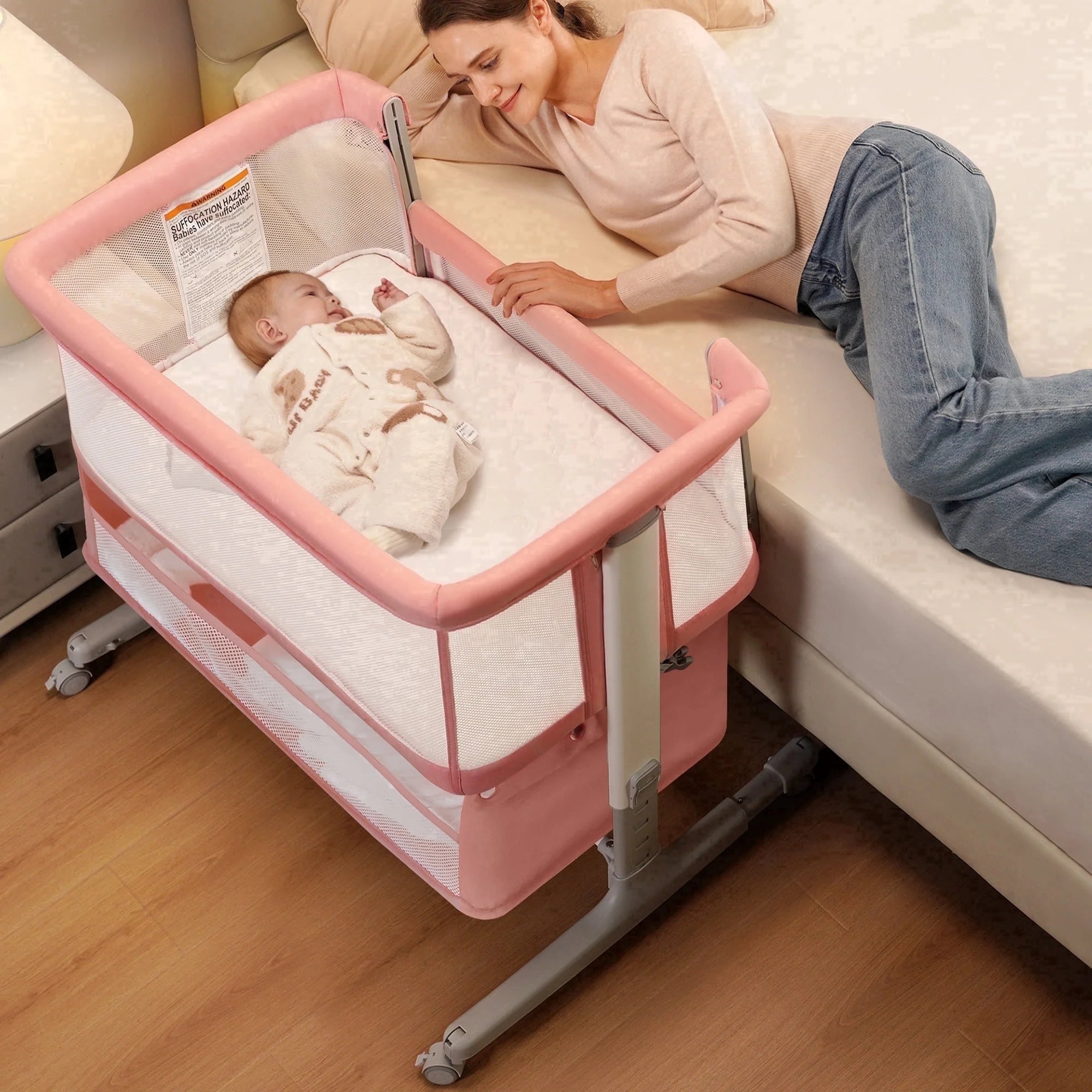
Bedside Bassinet for Tall Bed — Adjustable Height & Storage Basket
An adjustable-leg design aimed at platform, storage, and divan beds where standard bassinets stop a few inches short. Breathable mesh sides and a built-in storage basket for diapers, wipes, and swaddles within arm's reach.
What height range actually counts as "tall" for a bedside bassinet?
Most bedside bassinets are built for beds between 20 and 24 inches tall; a bed measuring 25 inches or higher is where you should start shopping specifically for a tall-bed or adjustable model.
That threshold isn't arbitrary — it lines up almost exactly with where mainstream bassinets stop adjusting. Below is how the adjustment ranges typically break down by bassinet category, based on published spec sheets across the category:
| Bassinet type | Typical height range | Works best for |
|---|---|---|
| Standard bedside bassinet | ~19–27 inches | Low platform beds, low-profile frames |
| Mid-range adjustable bassinet | ~22–31 inches | Standard frame + mattress combinations |
| Tall-bed adjustable bassinet | ~27–34 inches | Platform beds, storage beds, thicker mattresses |
| Specialized over-bed sleeper | ~34–42 inches | Very tall or adjustable bases, box-spring setups |
If your bed measures above roughly 34 inches — common with adjustable bases or a thick mattress stacked on a tall frame — a standard adjustable bedside bassinet won't reach, even at its highest setting. In that specific case, an over-bed style sleeper with a lowering wall, rather than a side-by-side bedside model, is the more realistic fit.
Is a bedside bassinet for a high bed actually safe to use?
Yes, provided it's ASTM F2194-certified, the straps are anchored to the bed frame itself rather than just tucked under the mattress, and the two sleep surfaces sit flush with no gap a baby's arm or leg could slip into.
Height adjustment doesn't compromise safety by itself — the certification standard applies at every setting, not just the factory default. What actually causes problems is a rushed setup: straps looped around a headboard post instead of the frame, a bassinet pushed up against a soft pillow-top mattress that compresses lower than the bassinet's rigid pad, or a gap left open because the bed height was measured before anyone was lying on the mattress.
Height gets all the attention, but base clearance quietly disqualifies more bassinets than height does. Several popular bedside bassinets — including some of the tallest-adjusting models on the market — use a wide leg base designed to slide partially under the bed frame. A platform bed with a solid base or built-in drawers has nowhere for those legs to go, so the bassinet simply can't get close enough to the mattress no matter how tall its adjustment range is.
Before you shop by height alone, check whether your bed frame has open space underneath it. If it doesn't, filter specifically for a free-standing base design rather than a leg-under-bed design, regardless of the advertised height range.
Bedside bassinet vs. adjustable bedside bassinet vs. standalone bassinet — what's actually different?
A standard bedside bassinet has one or two fixed height options, an adjustable bedside bassinet has four or more incremental settings for a closer fit to your specific bed, and a standalone bassinet has no bed attachment at all and simply sits on its own legs anywhere in the room.
Adjustable bedside bassinet wins when...
- Your bed height falls outside the "average" 20–24 inch range
- You want the sleep surface flush against your mattress for reaching over, not sitting up
- You're recovering from a C-section or have limited mobility at night
- You plan to fine-tune the fit after your mattress settles or you switch bedding
Standalone bassinet wins when...
- You want to move the bassinet between rooms freely, not just beside one bed
- Your bed frame has no clearance for a wide leg base underneath it
- You're setting up in a nursery rather than directly beside your own bed
- Budget matters more than arm's-reach convenience
What key features actually matter when you're shopping for a tall-bed bedside bassinet?
Beyond height, the features that make the biggest difference for tall beds are the minimum height setting, base clearance, strap anchoring, mesh airflow, and mattress firmness — in that order of importance.
- Minimum height setting: the single most important spec, and the one most product pages bury below the maximum height in the fine print.
- Base clearance style: a free-standing base works with any bed frame; a leg-under-bed base only works if your frame has open space underneath.
- Strap anchoring points: look for straps rated to wrap around a bed frame rail, not just hook over a mattress edge.
- Breathable mesh sides: four-sided mesh keeps airflow consistent regardless of how high the bassinet sits, which matters more at taller heights where warm air can pool.
- Firm, flush-fitting mattress pad: a pad that compresses more than your bed's mattress creates a height mismatch even after you've adjusted the legs correctly.
- Storage basket placement: useful at any height, but especially so on a tall bed where bending down to a floor-level diaper bag mid-feed isn't practical.
Bedside Bassinet for Tall Bed — Adjustable Height & Storage Basket
Free-standing base (no leg-under-bed requirement), frame-anchored straps, four-sided breathable mesh, and a firm flush-fit mattress pad sized to sit level with tall platform and storage beds.
What problems do parents with tall beds run into most often, and how do you actually solve them?
The three problems that come up repeatedly are a visible gap between the mattresses, legs that won't fit under a platform bed, and a bassinet that fits on day one but not after the mattress settles — each has a specific, practical fix.
Problem: there's a visible gap between the two mattresses
Solution: re-measure with someone actually lying on the adult mattress, since memory foam and pillow-tops compress up to half an inch under body weight. Adjust the bassinet to that compressed height, not the empty-bed height, and re-check the gap weekly for the first month as a new mattress continues to break in.
Problem: the bassinet's legs won't slide under a platform or storage bed
Solution: stop shopping by height alone and filter specifically for a free-standing base design. These bassinets rest entirely on their own footprint beside the bed rather than requiring floor clearance underneath it, which sidesteps the platform-bed problem completely regardless of your bed's height.
Problem: the fit was perfect at setup but drifted off over a few weeks
Solution: this is almost always the mattress settling, not the bassinet failing. Re-check the height match after the first two weeks of nightly use, since most mattresses lose their initial firmness during that window, and re-tighten the straps at the same time — strap webbing stretches slightly with regular use too.
Who is a bedside bassinet for a tall bed actually best for?
It's the right choice for parents with a platform, storage, or divan bed 25 inches or taller who want arm's-reach access without getting out of bed for nighttime feeds — and a poor fit for anyone whose bed already measures under 22 inches, where a standard bassinet is simpler and usually cheaper.
- Best for: C-section recovery, breastfeeding parents who feed lying down, small bedrooms where a full standalone bassinet doesn't fit beside the bed, and any bed with a mattress topper or thick pillow-top pushing total height above average.
- Less ideal for: co-sleeping households who plan to move the bassinet between rooms often, very low platform or floor beds, and anyone prioritizing budget over the adjustment range.
Bedside Bassinet for Tall Bed — Adjustable Height & Storage Basket
Sits flush with platform, storage, and divan beds up to the tall end of the standard range, so nighttime feeds don't require getting up.
How do you set up and secure a bedside bassinet on a tall bed, step by step?
- Measure your bed with someone lying on it. Record the compressed mattress-top height, not the empty-bed height.
- Set the bassinet to the matching height increment, rounding down slightly rather than up if your bed falls between two settings — a bassinet sitting a touch below your mattress is safer than one sitting above it.
- Position the bassinet against the bed and check for gaps at both ends, not just the middle, since an uneven floor or headboard clearance can tilt the fit.
- Anchor the straps to the bed frame itself, looping them around a solid frame rail rather than the mattress or box spring, then pull them fully taut.
- Push down firmly on the bassinet rail to confirm it doesn't shift away from the bed under light pressure before the first use.
- Re-check the fit after two weeks of regular use, once the mattress has had time to settle into its normal shape.
Bedside bassinet for tall bed: quick answers
How do I know if my bed is too tall for a regular bedside bassinet?
Measure from the floor to the top of your mattress. If that number is 25 inches or higher, a standard bedside bassinet likely won't reach, and you should look specifically for a bassinet with an adjustable or tall-bed height range instead. Beds with a box spring, storage frame, or thick pillow-top mattress are the most common culprits.
What's the difference between a bedside bassinet for a tall bed and one for a high bed?
They describe the same product category — "tall bed" and "high bed" are used interchangeably by shoppers and retailers. Both terms refer to bassinets built with an extended height-adjustment range, typically starting around 27 inches, specifically to reach mattresses that sit above the average bed height.
Will an adjustable bedside bassinet fit any bed frame?
No. Height adjustment solves the vertical mismatch, but base clearance is a separate issue. Bassinets with legs designed to slide under the bed need open floor space beneath the frame, which platform beds and storage beds usually don't have. Check for a free-standing base design if your bed frame is solid underneath.
Is it safe to use a bedside bassinet at its maximum height setting?
Yes, as long as the bassinet is ASTM F2194-certified, that certification applies at every height setting the manufacturer offers, not just the default one. The safety requirement is a flush fit with no gap and frame-anchored straps — the specific height used doesn't change those requirements.
How long can a baby use a bedside bassinet before switching to a crib?
Most bedside bassinets are rated for use until the baby reaches the manufacturer's weight limit (commonly 20–33 lbs) or begins pushing up on hands and knees or rolling over independently, whichever happens first — typically somewhere between 4 and 6 months. Check your specific product's weight and mobility limits rather than relying on age alone.
Do I need to buy a bed riser instead of an adjustable bassinet if my bed is extremely tall?
If your bed measures above roughly 34 inches, most adjustable bedside bassinets won't reach even at their maximum setting. In that case, a specialized over-bed sleeper with a taller adjustment range is a more reliable fix than a bed riser, since risers change your own sleeping height rather than the bassinet's.
What's the bottom line?
Buy by minimum height, not maximum height, and check your bed frame's base clearance before you check anything else. Those two numbers eliminate more mismatched purchases than any feature comparison ever will.
If your bed measures 25 inches or higher and has open space underneath the frame, the Bedside Bassinet for Tall Bed with Adjustable Height & Storage Basket is built around exactly that range, with a free-standing base so a platform or storage bed isn't a dealbreaker.
- Travel Essentials for Baby — the full collection of nursery and on-the-go picks, including this bassinet.
- Bedside Bassinet for Tall Bed — Adjustable Height & Storage Basket — full specs, height range, and availability.


