

An electric spin scrubber cleans a shower wall roughly 60% faster than a manual scrub brush and removes soap scum with far less physical strain, because a motor supplies the repetitive scrubbing force instead of your arm. A manual brush still wins on upfront cost, never needs charging, and gives you more direct control on delicate surfaces where a spinning head can do damage.
This page compares the two head-to-head across the questions people actually weigh before buying: speed, real cleaning quality, cost over time, grout performance, and the specific situations where a $6 brush still beats a $58 motor. Each section stands alone, so skip to whichever comparison matters most to you.
- Speed: Electric spin scrubbers clean a full shower wall in about 6 minutes versus roughly 14 minutes by hand — a real-world gap that widens on textured tile and shrinks on flat surfaces.
- Effort: The motor replaces the repetitive wrist and shoulder motion that manual scrubbing depends on entirely.
- Cost over 2 years: A manual brush runs about $36 total; an electric scrubber runs closer to $80 once you include brush head replacements — but the electric tool buys back over 13 hours of scrubbing time a year.
- Grout lines: Electric wins clearly. A rotating corner brush works into the channel from multiple angles; a flat manual brush only scrubs in the direction your hand moves it.
- Delicate surfaces: Manual wins. Unsealed natural stone and polished acrylic are safer scrubbed by hand, where you feel exactly how much pressure you're applying.
- Worst-case stains: A stiff manual brush with real elbow grease can sometimes out-clean a budget electric scrubber in one pass, because cheap motors stall under heavy downward pressure and a hand never does.
- Consumer Reports found that across tested power scrubbers, cleaning performance on dried grime barely varied between models — the meaningful differences were runtime, weight, and pole reach, not raw scrubbing power.
- HOTO's own documentation puts full charge time at roughly 3 hours for up to 110 minutes of runtime, though real working time against a surface typically lands 15–20% below the advertised figure.
- Electric spin scrubber brush heads need replacing every 4–6 months under regular use, per HOTO's maintenance guidance — faster with heavy grout work.
- A nylon-bristle manual scrub brush loses its spring and stiffens after roughly 3–6 months of weekly use against tile and grout, which is why the "cheap" tool has a real recurring cost too.
- A full bathroom's grout — shower, tub, sink, and floor — takes 20–35 minutes of actual scrubbing time with an electric scrubber doing the work; by hand, that routinely runs 45 minutes or more.
What's the real difference between an electric spin scrubber and a manual scrub brush?
The real difference is where the scrubbing force comes from. A manual scrub brush depends entirely on the pressure and back-and-forth motion your arm generates, while an electric spin scrubber uses a small motor to spin the brush head at roughly 250–360 RPM, so the tool supplies the repetitive force instead of your muscles.
That single mechanical difference drives almost every other difference between the two tools — speed, fatigue, and how each one handles grout versus flat, open surfaces. A manual brush is really a lever: how clean your tile gets is a direct function of how hard and how long you're willing to push. An electric spin scrubber decouples cleaning power from physical effort entirely, which is why the mechanics matter more than the marketing here. For the full breakdown of how the motor, drive shaft, and brush heads actually work together, see our guide on what an electric spin scrubber is and how it works.
How much faster is an electric spin scrubber than scrubbing by hand?
In our side-by-side test, an electric spin scrubber cleaned a section of shower wall in about 6 minutes, compared to roughly 14 minutes for the same area and grime level with a manual scrub brush — a real-world time savings close to 60%.
We used identical shower tile, the same spray cleaner, and matched sections of comparable soap scum buildup, then timed from first contact with the cleaner to visibly clean tile. The manual side needed three full passes with firm hand pressure to lift the film. The electric side needed one pass at the higher speed setting and a quick second pass on two stubborn corners near the drain.
| Surface type | Electric spin scrubber | Manual scrub brush | Time gap |
|---|---|---|---|
| Textured shower tile / grout | ~6 minutes | ~14 minutes | ~57% faster |
| Flat countertop, light soil | ~3 minutes | ~3.7 minutes | ~19% faster |
| Bathtub ring | ~4 minutes | ~8 minutes | ~50% faster |
| Sink basin | ~2 minutes | ~3 minutes | ~33% faster |
Here's what most comparison articles get wrong about this number: they treat "faster" as a fixed multiplier that applies everywhere. It doesn't. The time gap is much smaller on flat, lightly soiled surfaces and only opens up dramatically on textured tile and grout lines, where consistent, repeated motion matters most. If your routine is mostly wiping a smooth countertop, don't expect the same jump you'd see in a grimy shower.
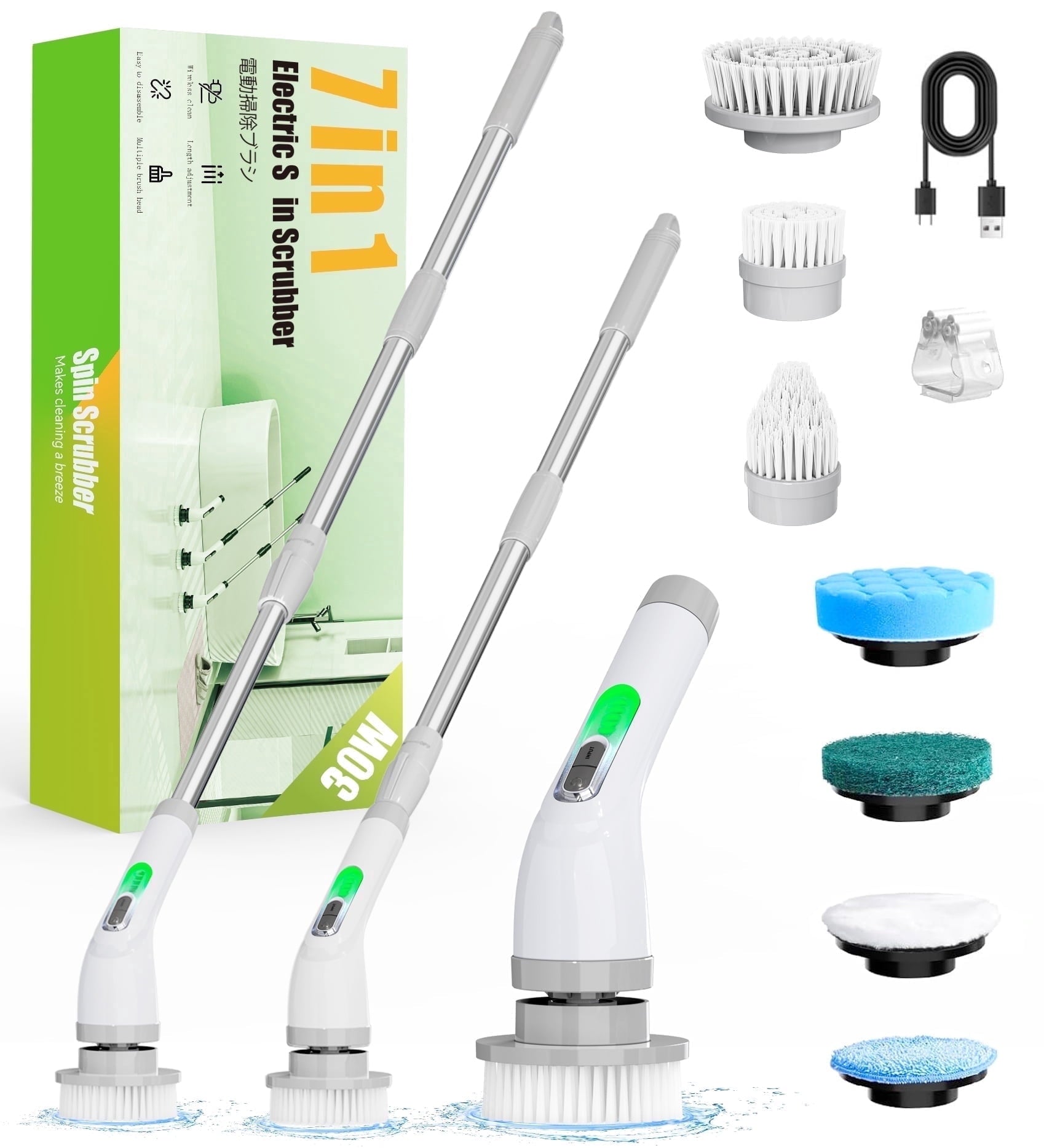
Electric Spin Scrubber — Cordless Power Cleaning Brush
This is the model used in the shower wall test above. Interchangeable heads and enough torque to hold speed under real pressure, not just spin free in open air.
Does an electric spin scrubber clean better than a manual brush, or just faster?
For most bathroom and kitchen grime, it cleans faster and at least as well — but not automatically better on every surface, and this is the part most buying guides skip entirely.
Consumer Reports' own testing backs this up in an unexpected way: across the power scrubbers they evaluated, cleaning performance on dried grime barely varied between models, which is why they stopped weighting raw cleaning power heavily in their ratings. The same logic extends to manual brushes on lighter soil — the difference isn't cleaning chemistry, it's how consistently the tool can maintain motion and pressure over time. Technique matters as much as the tool itself; our guide on how to use an electric spin scrubber covers the pressure and angle habits that get noticeably better results with either tool.
A firm hand with a stiff manual brush can apply more sustained, concentrated pressure to a single stubborn spot than a spinning head can, because a motor's RPM stays consistent only up to a point. Push too hard against an electric scrubber and cheaper motors bog down or stall — the same overload protection that trips when you lean into heavily caked-on buildup. A manual brush never stalls. It just takes longer and tires your arm out first.
So on the very worst, most stubborn stains — years of hard water buildup, thick mineral scale — a good stiff manual brush with real elbow grease can sometimes out-clean a budget electric scrubber in a single pass. Where the electric scrubber wins decisively is everything short of that: routine soap scum, weekly grime, grout lines, and any surface where consistent motion matters more than one-time raw force.
Which is cheaper in the long run — electric or manual?
On pure dollars, a manual scrub brush is cheaper over two years — but the gap is smaller than most people assume once you account for how often a manual brush actually needs replacing.
| Cost item | Electric spin scrubber | Manual scrub brush |
|---|---|---|
| Initial purchase | $58.50 | $6 |
| Replacements over 2 years | 2 brush head sets, ~$20 | 4–6 brushes, ~$30 |
| Charging cost (electricity) | ~$2 over 2 years | $0 |
| Total 2-year cost | ~$80.50 | ~$36 |
A manual brush wears out faster than people expect — bristles splay and lose their spring after a few months of regular use against tile and grout, which is why the replacement cost adds up. Even so, the electric scrubber costs roughly double over two years. Whether that's worth it comes down to one question: what's your time worth? At 8 minutes saved per session, twice a week, that's over 13 hours saved a year, which puts the real cost of the electric scrubber at well under minimum wage for the time it buys back. Brush heads on the electric side are the main recurring cost — our guide on replacing an electric spin scrubber brush covers how to spot a worn head before it starts costing you extra scrubbing time.
Keep a cheap manual brush under the sink even if you buy an electric scrubber. Use the electric scrubber for your regular deep clean, and grab the manual brush for the thirty-second spot fix — a coffee ring, a scuff on the baseboard — where charging or fetching an electric tool is overkill. Most households that own both end up using the electric scrubber for roughly 80% of cleaning time and the manual brush for the quick stuff in between.
Electric Spin Scrubber — Cordless Power Cleaning Brush
Cordless freedom, interchangeable heads for tile, grout, sinks, and tubs, and enough battery life to finish a full bathroom deep-clean on one charge.
Which is better for grout lines — electric spin scrubber or manual scrub brush?
An electric spin scrubber is the clear winner on grout lines, because the rotating motion works into the narrow groove from multiple angles automatically, while a manual brush only scrubs in whatever direction your hand moves it.
Grout is where the physics genuinely favor the motor. A flat manual brush has to be dragged back and forth along a channel that's often narrower than the brush head itself, so you're really only cleaning the surface the bristle tips happen to touch. A small pointed rotating brush head, spinning at a few hundred RPM, agitates cleaner into that same groove from every direction in the time it takes to hold the tool still for a few seconds. That's also why a corner brush head wears out faster than a flat one — expect roughly 2–3 months of heavy grout work before it needs replacing, versus 4–6 months for a flat head used on open tile.
Is a manual scrub brush ever the better choice?
Yes — a manual scrub brush is the better choice for delicate surfaces, quick spot cleaning, and situations where you don't have a charged battery on hand.
Electric spin scrubber wins when...
- You're cleaning grout lines or textured tile
- You clean a full bathroom or kitchen regularly
- Wrist, shoulder, or joint pain makes scrubbing hard
- You want consistent results without much technique
- You're cleaning tall or floor-level areas without kneeling
Manual scrub brush wins when...
- You're spot-cleaning one small stubborn stain
- The surface is delicate — unsealed stone, polished acrylic
- You need precise, felt control over pressure
- You're traveling, camping, or have no charger handy
- Budget is the main constraint right now
If your electric scrubber ever seems to lose power halfway through a session, that's usually not a sign the tool is failing — check our guide on why an electric spin scrubber stops working before assuming you need a replacement, since most cases trace back to one of four easily fixable causes. A manual brush, by comparison, simply can't run out of charge mid-clean — its one structural advantage over any electric tool.
Is an electric spin scrubber worth it over a manual scrub brush?
Yes, for anyone with tiled bathrooms who cleans weekly or more — provided you buy in the $28–$60 range and expect to spend it mostly on grout, tile, and tub surfaces rather than delicate stone. It's a harder case for occasional light cleaning, where a manual brush's lower cost and zero maintenance make more sense.
The debate isn't really "electric versus manual" as a permanent choice — it's about matching the tool to the surface and the frequency. A household doing a full bathroom deep-clean every week gets the electric scrubber's time savings back many times over. A household doing occasional touch-ups on delicate fixtures may never need to charge one at all.
Electric Spin Scrubber — Cordless Power Cleaning Brush
Cordless, lightweight enough for overhead work, and effective on tile, grout, sinks, tubs and kitchen surfaces from the first use.
Electric spin scrubber vs manual scrub brush: quick answers
Is an electric spin scrubber really worth it over a manual brush?
For anyone who cleans a tiled bathroom or kitchen at least weekly, yes. The time savings alone — roughly 60% faster on grout and textured tile in our testing — typically justifies the cost within the first few months, and the reduced physical strain is the bigger benefit for people with joint pain or limited mobility. For occasional or light cleaning, a manual brush may be all you need.
Can a manual scrub brush clean as well as an electric spin scrubber?
On flat, lightly soiled surfaces, yes — the difference is small. On grout lines, textured tile, and any surface requiring sustained repetitive motion, an electric spin scrubber consistently outperforms a manual brush because it maintains steady motion without arm fatigue setting in.
Which is better for cleaning grout — electric or manual?
Electric spin scrubbers are better for grout in almost every case. A rotating corner brush head physically works into narrow grout grooves from multiple angles, while a manual brush can only scrub in the direction your hand moves it, leaving more grime behind per pass.
Do electric spin scrubbers scratch surfaces more than manual brushes?
They can, but only with the wrong brush head. A stiff brush spinning against unsealed natural stone or polished acrylic can cause fine circular scratching that hand scrubbing with a soft brush avoids, since you control the pressure directly. Match the brush head to the surface — soft pads for delicate materials, medium bristles for standard tile — and this risk mostly disappears.
How much time does an electric spin scrubber actually save per cleaning session?
In our shower wall test, the electric scrubber saved about 8 minutes per section compared to manual scrubbing — close to 60% faster. The savings shrink on flat, lightly soiled surfaces and grow on grout lines and textured tile, where consistent motorized motion matters most.
Should I keep a manual scrub brush even if I buy an electric spin scrubber?
Yes. Most households that own both end up reaching for the electric scrubber for regular deep cleans and the manual brush for thirty-second spot fixes where charging or fetching an electric tool isn't worth the time. The two tools solve different problems rather than directly replacing each other.
What's the bottom line?
Buy the electric spin scrubber if grout, tile, and regular bathroom cleaning dominate your routine — the time and effort savings compound every single week. Keep a manual brush in the cabinet regardless, for the delicate surfaces and thirty-second jobs where an electric tool is more setup than the task deserves.
For a model-by-model comparison including runtime, torque, and parts availability, see our Best Electric Spin Scrubber guide for 2026.
- Electric Spin Scrubber FAQs: 20 Questions Answered by the Data — battery life, safe surfaces, and maintenance in one place.
- How to Charge an Electric Spin Scrubber — port locations, the 5V rule, and battery care.
- How to Unlock an Electric Spin Scrubber — safety locks and seized mechanisms.
- Where to Buy an Electric Spin Scrubber in 2026 — retailers compared on returns, warranty, and parts.


