

To remove a brush from an electric spin scrubber, power the unit off, hold the brush head still in one hand, and turn the main body quickly counterclockwise with the other. The head releases in about a second. Push-fit heads pull straight off instead, and button-release models need the collar held down first.
That grip is the opposite of what nearly every guide tells you, and it is the reason so many people conclude their brush head is jammed when it is not. Twisting the head while holding the body barely works on a used scrubber, because manufacturers add anti-slip texture to brush heads specifically so they do not loosen during cleaning.
- The technique that actually works: Grip the brush head, rotate the machine body counterclockwise in one quick decisive movement. Do not rock it back and forth — GoodPapa's own service guidance confirms rocking will not release it.
- Twist angle: Roughly 60° for triangular twist-lock shafts, a full 90° quarter turn for round twist-lock shafts.
- Push-fit heads: No twisting at all. Pull straight along the shaft axis while rocking gently side to side.
- Look for the unlock arrow. Most heads have a small directional marking moulded into the plastic base. If your model runs in reverse, the release direction flips with it.
- If it's stuck: Invert the scrubber so the handle points up, soak just the head in warm soapy water for 5–10 minutes, then retry with a dry cloth for grip.
- Never use WD-40 or penetrating oil. Manufacturer service advice explicitly warns against lubricants on these plastic collars — they can craze the plastic and contaminate the bristles permanently.
- Remove it after every clean, not just when swapping. A head left locked on a damp shaft is the single biggest cause of seized collars two months later.
- GoodPapa states that its brush heads carry an anti-skid design, meaning hand-twisting the head alone will not release it. Their instruction: hold the brush head, turn the main engine quickly in the unlocking direction, and check the unlock marking first.
- Tilswall's seller guidance on Amazon specifies rotating the handle — clockwise to lock, counterclockwise to remove — and emphasises a quick rotation rather than slow pressure.
- Expert service advice on the Bomves CB01 warns against excessive force or lubricants like WD-40, recommending a brief warm soapy soak of the connection area instead.
- ZaklnLife's user manual specifies a tug test after refitting: if the head comes off easily, it was never seated correctly.
- HOTO recommends replacing brush heads every 4–6 months and pads every 3 months under normal weekly use — so most owners perform this removal 2–4 times a year minimum.
How do you remove a brush from an electric spin scrubber step by step?
Remove the brush in five steps: power down completely, identify the connector, grip the head and turn the body, pull it straight off, then clean the shaft. The whole process takes under a minute once you know your connector type.
Work over a towel on a flat surface rather than inside the tub. A wet scrubber is slippery, and a dropped unit tends to land on the button housing.
-
Power off completely and disconnect the charger
Hold the power button until every indicator light goes dark. Many models cycle through speed settings before switching off, so a single press often leaves the motor armed. If the unit is charging, unplug it — a shaft that spins while your fingers are inside the head causes pinched fingertips.
-
Find the unlock marking on the head
Most brush heads have a small arrow or padlock symbol moulded into the plastic base showing the release direction. This matters because a minority of models run in reverse, and on those the release direction flips. Ten seconds of looking saves you from twisting the wrong way against a lock.
-
Hold the head still and turn the body — not the other way round
Wrap your fingers around the hard plastic collar of the brush head and keep it stationary. With your other hand, rotate the main body of the scrubber counterclockwise in one quick, decisive movement. Roughly 60° for a triangular shaft, 90° for a round one. You should feel a soft click or a clear drop in resistance.
-
Pull it straight off along the shaft axis
Once unlocked, the head lifts away with light pressure. If it unlocks but resists coming off, rock it gently side to side while pulling straight. Never pull at an angle — that bends the drive shaft and causes permanent wobble on every head you fit afterwards.
-
Clean the shaft before anything goes back on
Run a dry toothbrush around the shaft, then a cotton swab in the collar recess, then wipe with a barely damp cloth and dry it fully. Soap film and hard water scale build a thin crust that stops the next head seating properly, and that is what causes wobble two weeks later.
Slow, steady pressure lets the plastic flex and absorb your force. A fast rotation transfers torque before the collar can deform, which is why manufacturers specifically use the word quickly in their guidance. If you have been leaning into it for thirty seconds and nothing has moved, stop pushing harder and switch to a single sharp turn instead. And never rotate back and forth hoping to work it loose — that motion cancels itself out.
Which connector does your spin scrubber use?
Electric spin scrubbers use one of four connector systems: triangular twist-lock, round twist-lock, push-fit, or button release. Pull the head off once and look at the shaft — its shape tells you everything.
| Connector | How to spot it | Removal motion | Difficulty when worn | Watch out for |
|---|---|---|---|---|
| Triangular twist-lock | Three-sided post at the shaft centre | Hold head, turn body ~60° counterclockwise | Easy — flats give the mechanism purchase | Corners round off if repeatedly over-tightened |
| Round twist-lock | Cylindrical post with a notch or keyway | Hold head, turn body 90° counterclockwise | Moderate — round heads are hardest to grip | Use a dry cloth for grip; wet plastic slips badly |
| Push-fit | Smooth peg, no flats or notches | Pull straight off, no twisting | Easy at first, then too easy | Friction sleeve stretches; head starts flying off mid-clean |
| Button / collar release | Small button or sliding ring above the base | Press and hold the release, then pull | Depends entirely on the spring | Release spring corrodes if the tool is stored wet |
Best for: Twist-lock connectors suit anyone who cleans weekly and swaps heads often, because they hold firmly under load and still release cleanly. Push-fit suits light, occasional use where speed matters more than grip. Button release is the most secure of the four but the least serviceable, since the spring mechanism cannot be repaired at home.
If you are unsure which one you have, our companion guide on how to replace an electric spin scrubber brush covers fitting the new head, the bristle wear test, and whether third-party heads are worth buying for your connector.
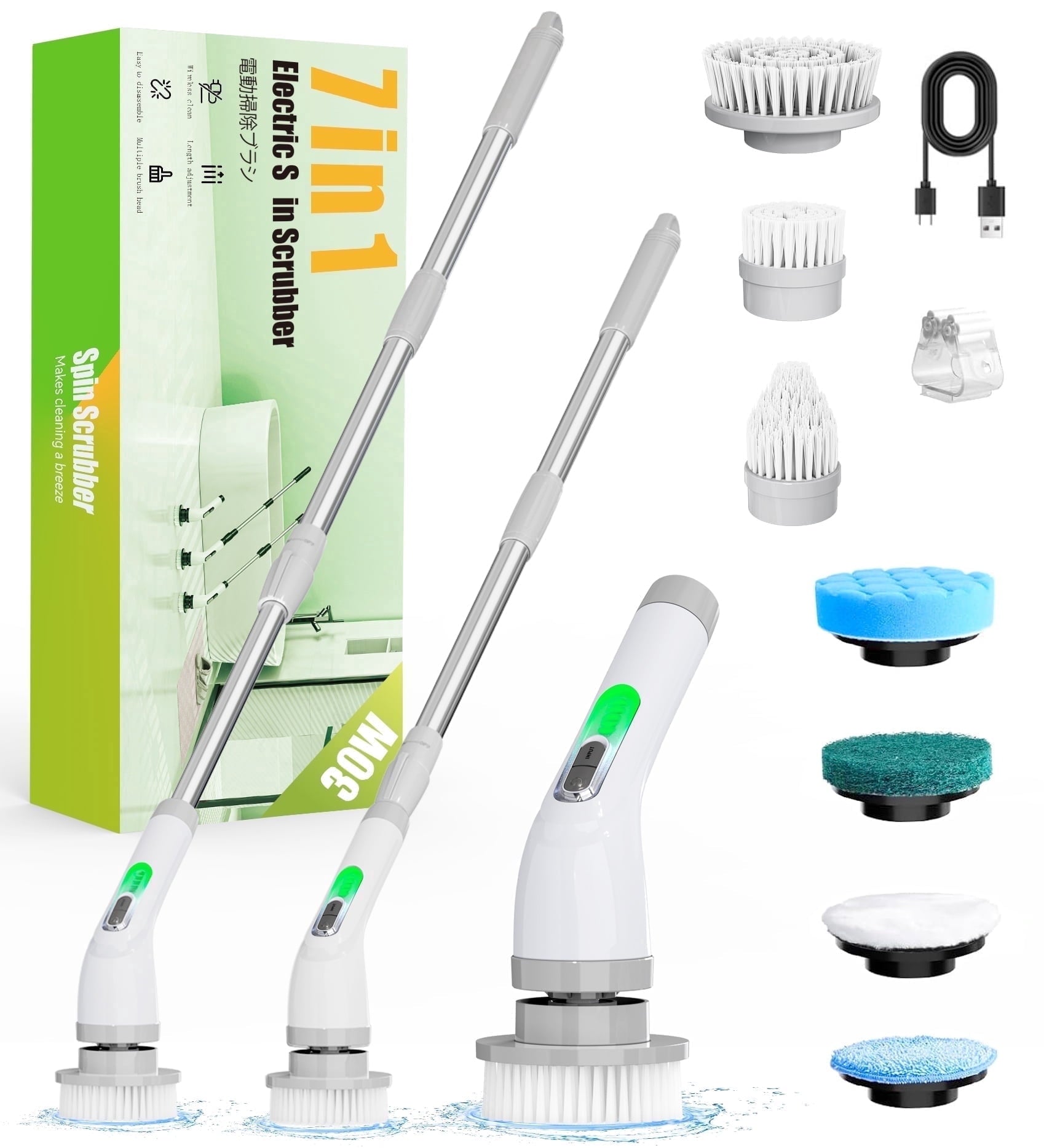
Electric Spin Scrubber — Cordless Power Cleaning Brush
Interchangeable heads for tile, grout, corners and fixtures on a standard shaft, so swapping attachments never turns into a wrestling match.
Why won't the brush head come off, and how do you fix it?
A brush head that will not come off is almost always held by limescale and dried soap inside the collar, not by a mechanical fault. Invert the scrubber so the handle points up, soak just the head in warm soapy water for 5–10 minutes, then retry.
The orientation is the part people get wrong. Keep the handle, buttons and charging port completely above the waterline. Water in the switch housing is a far more expensive problem than a stuck head.
| Problem | What's really causing it | The fix | What not to do |
|---|---|---|---|
| Head won't rotate at all | Limescale bonded inside the collar | Invert, soak head in warm soapy water 5–10 min, retry with a dry cloth for grip | No pliers — they crack the collar and leave a shaft nothing fits |
| Your hand slips on a round head | Anti-slip texture plus wet plastic | Wrap a dry microfibre cloth around the head, or wear a rubber glove | Don't squeeze the bristles — they flex and absorb the torque |
| Twists but won't lift off | Unlocked, but suction and residue still holding | Rock gently side to side while pulling straight along the shaft | Don't pull at an angle — that bends the shaft permanently |
| Nothing moves either direction | You're turning against the lock | Check the unlock arrow on the head; reverse-running models flip the direction | Don't force it "just a bit harder" — that rounds the lock corners |
| Head spins freely, never releases | Lock mechanism worn or corners rounded off | Hold the head firmly, sharp quick turn of the body; if it still fails, the shaft is worn | Don't shim it with tape — that hides the wear and worsens it |
Search any forum for a stuck spin scrubber head and you will find someone who freed theirs with WD-40. It does work, and that is exactly why the advice keeps spreading. But manufacturer service guidance for the Bomves CB01 explicitly warns against lubricants on these plastic collars, and there is a good reason: penetrating oils can craze certain plastics over time and they wick into bristle tufts, where no amount of rinsing removes them. You free the head once and then scrub your bathtub with an oil-contaminated brush.
Hot vinegar has the same problem from the other direction. It dissolves limescale beautifully, but heat plus acid softens the adhesive holding bristle tufts in their base plate. You win the battle and then watch the head shed bristles for a month. Warm water with a little dish soap does the same job on the collar without attacking anything.
Should you remove the brush head after every clean?
Yes — detaching the head after each use is the single highest-value habit for anyone who owns a spin scrubber. A damp head left locked on the shaft is what creates the seized collars people fight with two months later.
Here is what most maintenance guides get wrong. They tell you to rinse the brush, which is correct but incomplete. The water that matters is not on the bristles; it is trapped in the joint between head and shaft, where it sits against metal and plastic with no airflow.
Removing after every clean
- Collar stays free — no seized heads later
- Shaft dries fully, so no corrosion at the lock
- Kills the mildew smell people mistake for worn bristles
- Roughly doubles usable head life
- You spot wrapped hair before it jams the motor
Leaving it attached
- Faster — nothing to do after cleaning
- Head can't get misplaced in a drawer
- But: moisture sits in the joint indefinitely
- But: scale bonds the collar to the shaft
- But: hair collects at the shaft base unseen
The routine takes thirty seconds: rinse the head until the water runs clear, remove it, shake both parts out, wipe the shaft dry, and store the head bristles-up and detached. That is the entire preventive maintenance programme for this tool.
What are the key features that make head removal easy or painful?
Four design details decide whether removing a brush head takes five seconds or five minutes: connector type, base grip design, shaft material, and whether the unlock direction is marked on the head.
| Design feature | Easy to remove | Painful to remove | Why it matters |
|---|---|---|---|
| Base grip | Wide flat collar with ribbed edges | Smooth round base flush with bristles | Round heads give your hand nothing to hold, especially wet |
| Unlock marking | Arrow or padlock moulded into the plastic | No marking anywhere on the head | Without it you guess the direction and risk tightening the lock |
| Shaft material | Stainless or coated steel | Bare mild steel | Uncoated shafts corrode at the joint and bond to the collar |
| Collar depth | Shallow recess, easy to swab clean | Deep narrow recess | Deep recesses trap scale where a cloth can't reach |
| Connector standard | Triangular twist-lock | Proprietary button release | Standard shafts take generic heads; proprietary ones strand you |
None of this appears on a spec sheet, which is why it is worth checking product photos before buying. A listing that photographs the shaft and the head base separately is showing you what you need to see. One that only shows bristle-side glamour shots is hiding the joint. Our guide on where to buy an electric spin scrubber covers how to read listings for exactly this kind of detail.
Electric Spin Scrubber — Cordless Power Cleaning Brush
A standard shaft with heads for tile faces, grout lines, corners and fixtures — so attachments swap in seconds instead of seizing on.
How do you clean the brush head once you've removed it?
Rinse the removed head under warm running water until the water runs clear, work the bristles with your fingers to release trapped grime, then shake it out and dry it bristles-up. Skip the dishwasher entirely.
The dishwasher is tempting and it is a mistake. Sustained heat above 60°C softens the adhesive in the base plate, and the drying cycle can warp the plastic collar just enough that the head no longer seats squarely on the shaft. You end up with a clean head that wobbles.
- Warm water, not hot. Comfortable-to-touch is right. Hot water attacks the tuft adhesive.
- Work the bristles under the stream with your thumb — grime compacts at the base of each tuft where rinsing alone will not reach.
- Use a drop of dish soap for greasy kitchen heads, then rinse thoroughly so no residue dries in the tufts.
- Shake hard, then stand it bristles-up. Bristles-down traps water in the base plate.
- Keep a separate head for the toilet area and never rotate it into kitchen use. Colour-coding costs nothing.
While the head is off, take thirty seconds to check the shaft for wrapped hair. It compacts invisibly at the base over weeks, and once the friction exceeds what the motor can overcome, you get a unit that hums without spinning. If that has already happened, our guide on why an electric spin scrubber stops working walks through the diagnosis.
When does a stuck head mean the tool is finished?
A stuck head almost never means the tool is finished. The exception is a shaft whose lock corners have rounded off — at that point no head will hold, and replacing heads becomes pointless.
Test it this way. Fit a brand-new head and lock it. Tug it firmly. If a new head still slips or spins freely on the shaft, the shaft itself has worn, most often because the triangular post's corners rounded from repeated over-tightening. That is a body fault, not a head fault, and it is not repairable at home.
Everything short of that is recoverable:
- Seized by scale — soak and retry. Recoverable.
- Cracked collar on the head — the head is finished, the tool is fine. Fit a new head.
- Corroded release spring — usually recoverable with a soak and thorough drying.
- Rounded shaft corners — tool needs replacing.
- Bent shaft from angled pulling — tool needs replacing.
If you have reached one of the last two, our 2026 comparison of the best electric spin scrubber models covers runtime, torque and head availability across five tested units. And if the mechanism feels locked rather than seized, that is a different issue entirely — see how to unlock an electric spin scrubber.
Electric Spin Scrubber — Cordless Power Cleaning Brush
If new heads no longer hold, the shaft has gone. This one arrives ready for tile, grout, sinks and tubs with a full set of attachments.
Frequently asked questions about removing spin scrubber brushes
How do you remove a brush head from a spin scrubber that won't budge?
Hold the scrubber upside down with the handle pointing up and rest just the brush head in a bowl of warm soapy water for five to ten minutes. Keep the handle, buttons and charging port completely dry. Then wrap a dry microfibre cloth around the plastic base for grip, hold the head still, and turn the machine body counterclockwise in one quick decisive movement. Avoid pliers, which crack the collar, and avoid WD-40, which manufacturer service advice specifically warns against on these plastic parts.
Which way do you twist to remove a spin scrubber brush?
Counterclockwise on almost all models, because the motor spins clockwise and normal use tightens the head against the lock. Check for a small arrow or padlock symbol moulded into the plastic base first, since a minority of scrubbers run in reverse and flip the release direction. Triangular shafts need roughly 60° of rotation; round shafts need a full 90° quarter turn. If nothing moves in either direction, you are turning against the lock rather than dealing with a jam.
Why is my spin scrubber brush head so hard to grip?
Manufacturers add anti-slip texture to brush heads deliberately, so they do not loosen during cleaning — and that same texture works against you at removal time. GoodPapa's guidance confirms the head itself resists hand-twisting by design. Wrap a dry microfibre cloth around the base or wear a rubber washing-up glove for grip. Then hold the head stationary and rotate the machine body instead of trying to turn the head.
Can you remove a spin scrubber brush head while it's charging?
No. Always unplug the unit and power it off completely before touching the head. Many scrubbers keep the motor circuit live while charging, and models with multi-speed buttons often cycle into an active setting rather than shutting off on a single press. Wait until every indicator light goes dark, disconnect the cable, and dry your hands before starting.
How often should you take the brush head off your spin scrubber?
After every single use, not just when you swap attachments. Removing the head lets both the shaft and the collar dry properly, which prevents the limescale bonding and corrosion that cause seized heads months later. It also lets you spot hair wrapped around the shaft before it jams the motor. The full routine — rinse, remove, shake, wipe, store bristles-up — takes about thirty seconds.
Can you put spin scrubber brush heads in the dishwasher?
No. Dishwasher temperatures regularly exceed 60°C, and sustained heat softens the adhesive holding bristle tufts in the base plate. The drying cycle can also warp the plastic collar enough that the head no longer seats squarely on the shaft, leaving you with a clean head that wobbles when it spins. Rinse under warm running water instead and work the bristles with your fingers.
What do you do if the brush head breaks while you're removing it?
If the plastic collar cracks but the shaft is undamaged, only the head is finished — fit a replacement and carry on. Check the shaft carefully for rounded lock corners or any bend before fitting the new one. If a brand-new head also slips or refuses to lock, the shaft itself has worn and no replacement head will hold, which means the tool rather than the brush needs replacing.
What's the bottom line on removing spin scrubber brushes?
Reverse your grip. Hold the brush head still and turn the machine body, quickly and decisively, counterclockwise. That one change resolves the majority of "stuck" heads without soaking, tools, or force.
Check the unlock arrow before you twist, keep pliers and penetrating oils away from the collar entirely, and pull straight along the shaft rather than at an angle. If it genuinely will not move, a five-minute warm soapy soak with the handle pointing up solves nearly everything scale-related.
Then build the thirty-second habit: rinse, remove, dry, store detached. Do that after every clean and you will never fight a seized brush head again.
- Best Electric Spin Scrubber 2026: I Cleaned My Entire Bathroom in 8 Minutes — five models tested on runtime, torque and grout performance.
- How to Replace an Electric Spin Scrubber Brush in Under 60 Seconds — fitting the new head, the bristle wear test, and third-party compatibility.
- Why Is My Electric Spin Scrubber Not Working? — matching symptoms to causes for jams, overload trips and charging faults.
- How to Unlock an Electric Spin Scrubber: Complete Troubleshooting Guide — safety locks, stuck collars and jammed extension poles.
- How to Use an Electric Spin Scrubber: Full Guide — pressure, angles and cleaning solutions for better results.
- Where to Buy an Electric Spin Scrubber in 2026 — comparing retailers on returns, warranty and parts availability.


