

The best place to buy an electric spin scrubber is a specialist online store or the brand's own site, not a marketplace listing. You get a return policy attached to a real company, replacement brush heads that stay in stock, and a listing that cannot be quietly swapped for a different product after it collects reviews.
That last point surprises people. A spin scrubber is not a one-off purchase like a mop — it is a battery tool with consumable brush heads, so where you buy it determines whether you can still get parts in month fourteen. Here is how each buying channel actually compares.
- Best overall: A dedicated online cleaning-tools store or brand direct site. Single accountable seller, consistent stock of matching brush heads, real warranty contact.
- Best for speed: Amazon, if the listing says "Ships from and sold by Amazon." Third-party sellers on the same page carry different return terms.
- Best for touching it first: Lowe's, Target, or Best Buy — but expect two or three models on the shelf, not twenty.
- Avoid: Ultra-cheap $12–$18 units from unbranded overseas listings. The motor stalls under pressure and no replacement heads exist for the shaft.
- Price reality: The usable range is $28–$60. Below $25 you get a toy; above $100 you are paying for an outdoor-grade tool most homes never need.
- The one spec to verify: Battery runtime of 60+ minutes. A full bathroom takes 20–35 minutes, and real-world runtime lands 15–20% below the advertised figure.
- Check before checkout: Return window length, whether replacement brush heads are sold separately, the shaft connector type, and the water-resistance rating (IPX5 minimum, IPX7 preferred).
- 19.3% of all online sales were returned in 2025, and 82% of shoppers say free returns are a major factor in where they buy — up from 76% the year before (NRF & Happy Returns, 2025 Retail Returns Landscape).
- 71% of consumers will not shop with a retailer again after one bad returns experience. For a tool with a battery in it, the returns process matters more than the sticker price.
- The FTC's Consumer Reviews and Testimonials Rule took effect 21 October 2024, with civil penalties reaching $53,088 per violation. The FTC issued its first warning letters to 10 companies in December 2025 (Federal Trade Commission).
- The electric spin scrubber market hit $3.03 billion in 2025 and is forecast to reach $5.89 billion by 2034 at a 7.8% CAGR — which is exactly why hundreds of near-identical listings appeared in the last two years (Marketintelo).
- Manufacturers such as HOTO recommend replacing brush heads every 4–6 months and pads every 3 months, so parts availability is a recurring cost, not a one-time question.
Where is the best place to buy an electric spin scrubber?
Buy from a specialist store or brand-direct site if you want support and parts, and from Amazon if you want it tomorrow. Big-box retailers work when you need to handle the tool first, and unbranded overseas marketplaces almost never work out for a motorised product.
Each channel trades something away. The table below shows what you actually give up in each case.
| Where you buy | Typical price | Best for | The real trade-off | Parts availability |
|---|---|---|---|---|
| Specialist online store (e.g. Elite Essentials) | $40–$60 | Buyers who plan to keep the tool 2+ years | Fewer models to choose from than a marketplace | Strong — curated ranges keep matching heads stocked |
| Brand direct (HOTO, Rubbermaid) | $45–$90 | Warranty claims and guaranteed-fit accessories | Highest sticker price; slower shipping | Excellent while the model is current |
| Amazon | $25–$60 | Fast delivery and wide selection | Listings get relabelled; reviews may describe a different product | Mixed — generic heads plentiful, exact-fit ones vanish |
| Walmart / Target | $25–$50 | In-store pickup and easy in-person returns | Rotating stock; the model you liked may not return | Weak — rarely carries replacement heads at all |
| Lowe's / Best Buy | $50–$120 | Testing handle weight and lock feel before buying | Only two or three models stocked; premium pricing | Limited to the brands they carry |
| Unbranded overseas listings | $12–$20 | Almost nobody | Motor stalls under pressure; 30–60 day shipping; no recourse | None — the shaft often fits nothing else |
Here is what most buying guides get wrong: they rank these channels by price. Price is the least useful sorting criterion for a battery tool that needs consumables. Sort by whether you can buy a matching brush head in a year, and the ranking flips almost completely. Our tested comparison of the best electric spin scrubber models for 2026 covers which specific units hold up, and this guide covers where to get them safely.
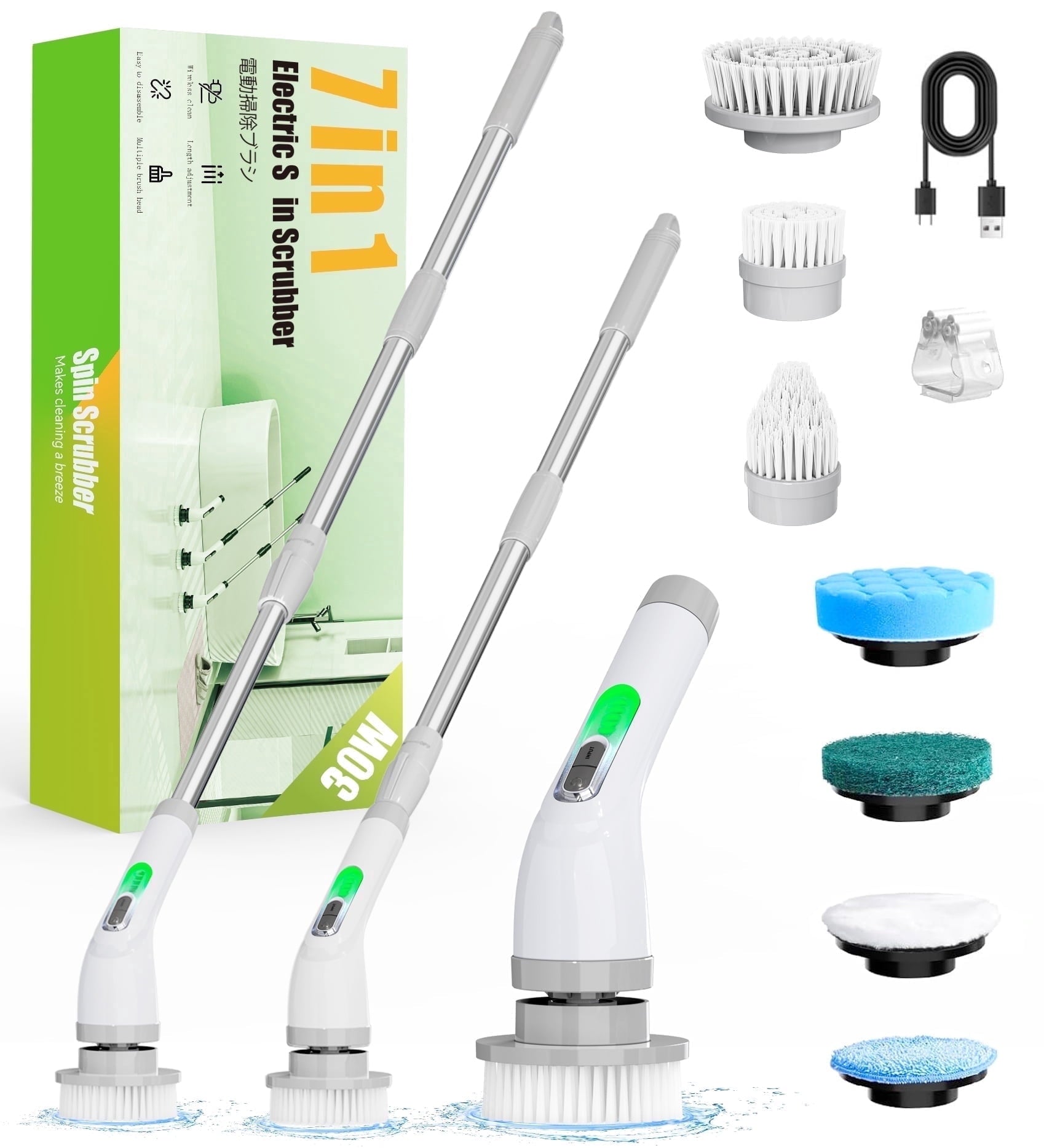
Electric Spin Scrubber — Cordless Power Cleaning Brush
Interchangeable heads for tile, grout, corners and fixtures, with a rechargeable battery sized for a full bathroom in one session.
What key features should you check before you buy?
Check five things: battery runtime, water-resistance rating, handle extension range, brush head connector type, and whether replacement heads are sold separately. Everything else on a spec sheet is secondary.
Work through them in this order, because the first two eliminate most bad listings within a minute.
-
Battery runtime — look for 60 minutes or more
A full bathroom including shower, tub, sink and floor grout takes 20–35 minutes of scrubbing. Advertised runtime typically overstates reality by 15–20%, so a "45 minute" unit gives you roughly 36 real minutes. That is fine for a sink, tight for a bathroom, and useless if you plan to carry on into the kitchen.
-
Water resistance — IPX5 is the floor, IPX7 is better
IPX5 means it survives splashing, which covers normal shower-stall use. IPX7 means the body tolerates brief immersion, which matters if you clean tubs or wash the unit under a tap. A listing that mentions no IP rating at all has usually not been tested, and that is the model that dies when water creeps into the charging port.
-
Handle extension — check both the minimum and maximum
Most listings advertise the maximum reach and hide the minimum. A pole that only collapses to 24 inches is awkward for sink and counter work, so you end up with a long tool for every job. The useful spec is a range that goes from roughly 12 inches up to 45 inches or more.
-
Connector type — photograph it before you need it
Triangular twist-lock shafts are close to an industry standard and take generic replacement heads. Push-fit and button-release systems are usually brand-specific. If the listing shows only the bristle side of the head and never the shaft, treat compatibility as unknown. Our guide on how to replace an electric spin scrubber brush explains how to identify each type.
-
Replacement heads — confirm they exist and are in stock
Search the seller's site for replacement heads before you buy the tool, not after. If nothing comes up, you are buying a scrubber with a fixed lifespan of a few months of good performance. This single check filters out more bad purchases than any review score.
Open the product photos and count how many show the tool in use versus how many are text-on-white graphics claiming "8-IN-1" or "500 RPM." Listings dominated by graphic banners rather than real photography almost always come from generic drop-shipped stock. Real sellers photograph the shaft, the charging port and the heads separately, because they expect you to ask about parts.
What problems do buyers run into, and how do you avoid them?
The five most common complaints are stalling motors, dead batteries within a year, heads that fly off, missing replacement parts, and returns rejected after the window closes. Every one of them is predictable from the listing before you buy.
When you read through buyer complaints across seller forums and marketplace Q&A sections, the pattern is remarkably consistent — almost nobody complains that the tool did not clean on day one. The complaints cluster around months three to twelve.
| Problem | Why it happens | How to avoid it at purchase |
|---|---|---|
| Motor stalls when you press down | Low-torque motor tuned for a high free-spin RPM number | Ignore headline RPM. Look for wattage (20W+) or torque figures, and reviews that mention grout specifically |
| Battery dies within a year | Small cell (under 2,000mAh) charged with a slow, unregulated adapter | Check mAh capacity and whether it uses USB-C. Anything under 2,000mAh is a light-duty tool |
| Brush head flies off mid-clean | Push-fit friction sleeve stretched, or a generic head with loose tolerance | Prefer twist-lock connectors over push-fit for anything you will use weekly |
| Cannot find replacement heads | Model discontinued; seller never stocked spares | Search for the heads before buying the tool. No listing means no parts |
| Return refused after the fault appears | 30-day marketplace window closes before the battery fault shows | Favour sellers with a documented warranty period, not just a return window |
| Unit arrives different from photos | Listing relabelled after accumulating reviews from an unrelated product | Read the newest reviews, not the top-rated ones, and check whether they describe the same item |
Everyone says to check reviews. For this product category, review volume is close to meaningless — listings get relabelled, review histories get merged across variants, and the FTC only began enforcing its fake-review rule with warning letters in December 2025. A 4.6-star average built on 12,000 reviews tells you far less than twenty recent reviews that mention grout, battery life at month six, and whether replacement heads arrived. Sort by most recent and read the three-star reviews. They are the only ones that describe the tool honestly.
Should you buy from a marketplace or a dedicated store?
Buy from a marketplace when speed and price matter most, and from a dedicated store when you want one accountable seller for the life of the tool. The difference shows up at the support stage, not the checkout stage.
Marketplaces (Amazon, Walmart, eBay)
- Fastest delivery, often next-day
- Widest model selection in one place
- Frequent discounts and coupon stacking
- Easy price comparison across sellers
- But: the seller behind the listing can change
- But: returns route through a third party, not the brand
Dedicated stores and brand sites
- One seller responsible for the whole lifecycle
- Matching brush heads stay stocked
- Clear, published warranty and return terms
- Curated range means fewer near-identical clones
- But: smaller catalogue to browse
- But: shipping is often a few days slower
Best for: Marketplaces suit anyone replacing a tool they already know, buying a gift, or needing it before the weekend. Dedicated stores suit first-time buyers, anyone who cleans weekly rather than occasionally, and households where the scrubber will get used on tile, grout and the car — because that combination burns through heads and makes parts availability the deciding factor.
Electric Spin Scrubber — Cordless Power Cleaning Brush
Rechargeable, lightweight enough for overhead work, and effective on tiles, grout, sinks, tubs and kitchen surfaces from the first use.
How much should you actually pay for an electric spin scrubber?
Pay between $28 and $60. Below $25 the motor cannot hold torque under pressure, and above $100 you are buying outdoor-grade equipment that most households will never fully use.
This is the clearest pattern across the whole category, and it holds regardless of brand.
| Price tier | What you get | Best for | Honest verdict |
|---|---|---|---|
| Under $25 | Small battery, single speed, no IP rating stated | Very light use: a single sink or a caravan | Skip it. The motor bogs down the moment you lean in |
| $28–$45 | 60–90 min runtime, 3–5 heads, extendable handle | Most households cleaning a bathroom weekly | The value sweet spot for routine cleaning |
| $45–$70 | IPX7 body, dual speed, better torque, USB-C charging | Tile, grout, kitchen and car in the same tool | Worth the step up if you clean more than one room |
| $100+ | High-torque motor, tool-brand battery platform | Decks, patios, driveways, heavy outdoor grime | Overkill indoors unless you already own the battery system |
One more counter-intuitive point worth making: a higher brush-head count is not a better deal. An eight-head kit sounds generous, but most households use three heads regularly and let the other five sit in a drawer. Two well-made flat brushes and a corner brush outperform a bargain eight-piece set, and they cost less to replace when the bristles lose their spring. If you are new to the tool, what an electric spin scrubber is and how it works explains why head shape affects results far more than head quantity.
What should you check right after your spin scrubber arrives?
Charge it fully, run it for two minutes on each speed, and test every brush head within the return window. Faults that appear later are usually visible in the first ten minutes if you know what to look for.
- Full charge first. Lithium cells ship partially charged. Run a complete charge cycle before judging runtime, or you will misjudge a healthy battery as a weak one.
- Listen at low speed. A healthy motor produces a steady hum. Ticking or grinding means a bearing or gear issue that will only get worse.
- Fit and remove every head. Each one should seat with light pressure and lock without wobble. A head that arrives loose will not tighten with use.
- Press into a textured surface. Push the running brush against a grout line for five seconds. If the motor bogs down or stops, the torque is inadequate and it needs to go back now, not in three months.
- Photograph the shaft. Keep the image on your phone. It makes ordering replacement heads trivially easy later.
If the unit seizes or the head locks up during that first test, it is usually a mechanism issue rather than a fault — our guide on how to unlock an electric spin scrubber walks through it. For technique that keeps a new tool working properly, how to use an electric spin scrubber covers pressure, angles and cleaning solutions.
Electric Spin Scrubber — Cordless Power Cleaning Brush
No compatibility guesswork, no relabelled listings, and no hunting for brush heads that were discontinued last year.
Frequently asked questions about buying an electric spin scrubber
Where can I buy an electric spin scrubber near me?
Lowe's, Target, Walmart and Best Buy all stock power scrubbers in their cleaning or floor-care aisles, and Best Buy carries the HOTO cordless model with in-store pickup. Expect a narrow selection — usually two or three models rather than a full range. Buying in person makes sense if you want to feel the handle weight and check how solidly the extension pole locks. If you want a specific model or guaranteed access to replacement brush heads, ordering online from a specialist store is the more reliable route.
Is it safe to buy an electric spin scrubber on Amazon?
Yes, if you check who the seller is. Look for "Ships from and sold by Amazon" or a recognised brand storefront, because third-party sellers on the same product page can apply different return terms. Sort reviews by most recent rather than most helpful, since older reviews sometimes belong to a different product that shared the listing. Also confirm replacement brush heads for that exact model are available before you order.
How much does a good electric spin scrubber cost in 2026?
A capable electric spin scrubber costs $28 to $60. That range gets you 60 to 90 minutes of runtime, an extendable handle, at least three brush heads and an IPX5 or IPX7 water-resistance rating. Units under $25 typically have motors that stall under pressure, while models above $100 are built for outdoor surfaces like decking and concrete. For standard bathroom and kitchen cleaning, spending past $70 rarely improves results.
What is the best electric spin scrubber to buy for a bathroom?
The best electric spin scrubber for a bathroom has 60+ minutes of runtime, an extendable handle that reaches shower walls without a step stool, and both a flat disc and a pointed corner brush. The corner brush matters most, because grout lines and the tub-to-wall joint are where manual scrubbing genuinely fails. IPX7 water resistance is worth prioritising in a wet room. Our full model-by-model comparison covers how five tested units perform on exactly these tasks.
Do electric spin scrubbers come with replacement brush heads?
Most include three to eight heads in the box, but that is not the same as replacements being available later. Included heads wear out in 4 to 6 months of weekly use, and pads last around 3 months. Before buying, search the seller's site for replacement heads that fit your model. If none are listed, the tool has a practical lifespan of a few months of peak performance regardless of how many heads shipped with it.
Should I buy an electric spin scrubber or use a drill brush attachment?
Buy a spin scrubber if you clean bathrooms weekly and want an extendable handle; use a drill brush if you already own a cordless drill and clean occasionally. Drill attachments cost $10 to $20 and deliver more torque, but they are heavy, awkward overhead, and most drills are not water-resistant. A purpose-built spin scrubber is lighter, safer around water, and reaches shower ceilings without you holding a drill above your head.
What is the return policy I should look for when buying one?
Look for a return window of at least 30 days plus a stated warranty period, because the two cover different failures. A return window protects you if the tool arrives faulty or underpowered; a warranty covers the battery degradation that typically shows up between months six and eighteen. Sellers offering only a return window and no warranty are the riskiest option for a battery-powered tool. Free returns matter too — 82% of shoppers now treat them as a deciding factor.
What is the bottom line on where to buy?
Buy from whoever will still answer the phone in a year. For a cordless tool with consumable brush heads, that single filter beats price comparisons, star ratings and spec-sheet RPM numbers combined.
Practically, that means a specialist store or brand-direct site for most people, Amazon when you need it fast and the seller is clearly identified, and a big-box store when you genuinely want to hold the tool first. Set your budget at $28 to $60, insist on 60+ minutes of runtime and an IPX5 rating at minimum, and check that replacement heads exist before you check out.
Do those four checks and you will avoid nearly every complaint that shows up in this category three months after purchase.
- Best Electric Spin Scrubber 2026: I Cleaned My Entire Bathroom in 8 Minutes — five models tested on runtime, torque and grout performance.
- How to Replace an Electric Spin Scrubber Brush in Under 60 Seconds — connector types, the bristle wear test, and stuck-head fixes.
- How to Use an Electric Spin Scrubber: Full Guide — pressure, angles and cleaning solutions for better results.
- How to Unlock an Electric Spin Scrubber: Complete Troubleshooting Guide — what to do when the mechanism seizes.
- What Is an Electric Spin Scrubber and How Does It Work? — the mechanics behind rotation, torque and head design.


