

To measure your bed height for a bassinet, stand a tape measure flat on the floor beside the exact spot where the bassinet will sit, and read the number at the very top of your mattress — not the frame, not the headboard, and not an empty corner of the room.
That one measurement decides whether a bedside bassinet will sit flush against your bed or leave a gap wide enough for a baby's arm. This guide walks through the exact tools, the step-by-step method, the mistakes that throw the number off by an inch or more, and how to read your result against real bassinet height ranges.
- Measure to the mattress top, not the frame. A tape measure placed at the floor and read at the top of the mattress, with someone lying on it, gives the number that actually matters.
- Most adult beds measure 24–30 inches from floor to mattress top once frame, foundation, and mattress are all stacked together.
- A body on the mattress compresses it by about a quarter to half an inch, which is why measuring an empty bed slightly overstates your real number.
- Match your number to the bassinet's lowest setting, with margin. A bassinet whose minimum height is 27 inches needs a bed at or below 27 inches — not just "close to" its range.
- Re-measure after two weeks of nightly use, since new mattresses settle and lose roughly half an inch of loft during that window.
- Total bed height (frame + foundation + mattress) averages 24–25 inches for a standard setup and commonly reaches 28–30 inches with a pillow-top mattress or storage-drawer frame, per Sleep Foundation and Casper bed-height data.
- Published bedside bassinet specs range widely: one popular model adjusts between 19.5 and 25 inches, another between 26.5 and 30.5 inches across five settings — a gap of nearly a foot between "compact" and "tall bed" models on the market today.
- A standard bedside bassinet footprint runs roughly 35 inches long by 20 inches wide, so measuring floor space alongside height avoids a second surprise after the height fits.
- Bassinets sold in the U.S. must meet the CPSC's federal bassinet standard and are tested against ASTM F2194 — a certification that applies at every height setting, not only the factory default.
What tools do you actually need to measure your bed height for a bassinet?
You need a tape measure at least 40 inches long, a flat floor to stand it on, and ideally a second person — a soft cloth tape measure works, but a rigid metal one gives a straighter, more accurate reading against a mattress edge.
- A tape measure, 40+ inches: most adult beds run 24–30 inches, so a short 12-foot fabric tape or a standard retractable tape both work fine as long as it reaches comfortably above the mattress.
- A notepad or your phone: you'll want to record more than one number (explained below), and trying to hold them all in memory is where mistakes creep in.
- A second person, if possible: one person holding the tape at the floor while the other reads the number at mattress height is far more accurate than balancing a tape measure alone.
- A flat, level spot on the floor: carpet padding, a rug, or an uneven floorboard can shift your reading by half an inch or more — note this and re-check at the exact spot the bassinet's legs will actually rest.
How do you measure your bed height for a bassinet, step by step?
Stand the tape measure flat on the floor at the exact side of the bed where the bassinet will go, extend it straight up, and read the number at the top of the mattress while someone lies on the bed — that reading is your working bed height.
- Choose the exact spot first. Bed height can vary by half an inch or more between the head and foot of the bed if your mattress isn't perfectly level, or if your floor slopes slightly, so measure at the precise location the bassinet will sit, not just "somewhere along the side."
- Stand the tape measure flat on the floor. Don't rest it against the bed frame's leg or a nightstand — place it directly on the floor, touching the same surface the bassinet's legs will stand on.
- Extend it straight up to the mattress top. Keep the tape vertical, not angled toward the bed, since even a slight lean adds an inch or more to a false reading.
- Have someone lie on the mattress while you read the number. An empty mattress sits higher than one with body weight on it — memory foam and pillow-tops in particular compress noticeably once someone's lying down.
- Write down both the empty and loaded readings. The gap between them tells you how much your specific mattress compresses, which matters more for softer, thicker mattresses than firm ones.
- Repeat at the foot of the bed if the mattress is older or sagging. A mattress that's lost support in the middle can measure differently at different points along its length.
Here's what most measuring guides skip entirely: they tell you to measure the bed once and stop. In practice, the loaded measurement — with someone actually lying on the mattress — is the number that determines whether a bassinet sits flush or leaves a gap, and it's routinely a quarter to half an inch lower than the empty-bed number most people write down.
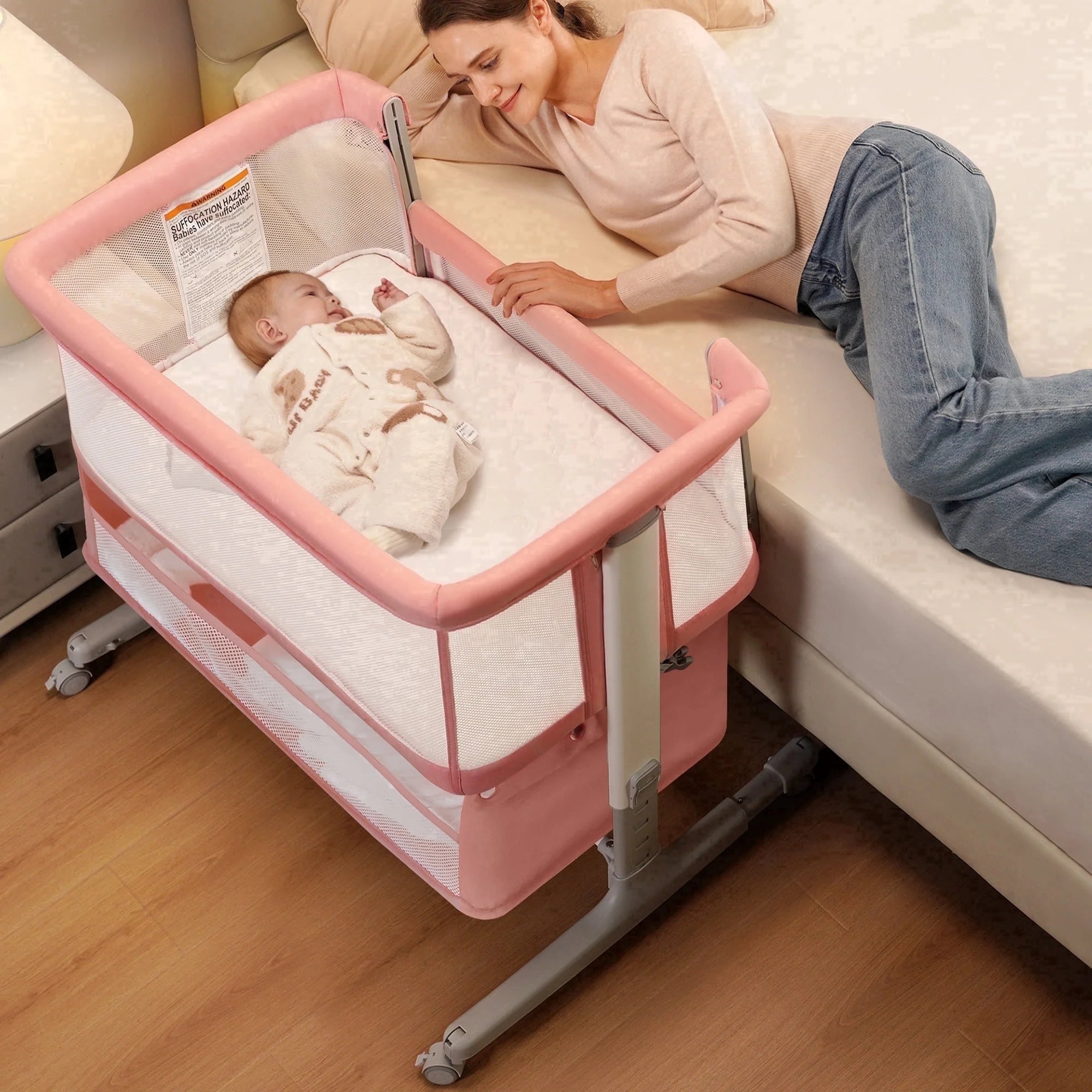
Bedside Bassinet for Tall Bed — Adjustable Height & Storage Basket
Built with a wider adjustment band for platform, storage, and divan beds where standard bassinets stop a few inches short of the mattress top.
What's the difference between bed height and mattress height measurement for a bassinet?
Bed height is the full floor-to-mattress-top measurement you need for a bassinet, while mattress height measurement refers only to the thickness of the mattress itself — and confusing the two is one of the most common reasons a bassinet doesn't fit.
Mattress height alone (typically 10–15 inches) tells you almost nothing about whether a bassinet will reach your bed, because it ignores the frame and foundation underneath. A platform bed with a 12-inch mattress and a bed frame with a box spring plus a 12-inch mattress can both have "12-inch mattresses" while sitting at completely different total heights — 18 inches versus 30 inches isn't unusual. When a bassinet's product page lists a height range, that range refers to total bed height (floor to mattress top), not mattress thickness on its own. If you only measure the mattress and skip the frame and foundation beneath it, your number will be several inches short of the one you actually need.
How tall should a bedside bassinet be for your specific bed?
A bedside bassinet should be set to a height at or slightly below your bed's loaded mattress-top measurement, so the sleep surfaces sit flush with no visible gap between them.
| Your measured bed height | Bassinet range to look for | Typical bed type |
|---|---|---|
| Under 22 inches | ~19–25 inches (compact/standard range) | Low platform or low-profile frame |
| 22–26 inches | ~22–30 inches (mid-range adjustable) | Standard frame + mattress combination |
| 26–34 inches | ~27–34 inches (tall-bed adjustable) | Platform, storage, or divan bed |
| Above 34 inches | Specialized over-bed model, ~34–42 inches | Adjustable base or very tall frame |
Round down, not up, if your measurement falls between two settings on a bassinet's adjustment range. A bassinet sitting a touch below your mattress top is a minor, easily fixed gap; one sitting above it creates a ledge a baby could roll toward, which is the version of "close enough" you want to avoid.
What measuring mistakes lead to a poor bassinet fit?
The three mistakes that come up again and again are measuring an empty mattress instead of a loaded one, measuring at the wrong spot along the bed, and forgetting to account for a mattress topper that isn't attached during the initial fitting.
Standing a tape measure on a thick rug or memory-foam carpet pad, rather than the bare floor, is an easy way to lose a quarter-inch to half-inch of accuracy without noticing. It sounds trivial, but a bassinet's legs will compress that same carpet differently than your open palm does while you're holding the tape steady. If your bedroom floor is carpeted, press the tape measure's base down firmly, the way the bassinet's actual feet will sit, rather than resting it lightly on top of the pile.
- Measuring an empty bed: always take a second reading with someone lying on the mattress, since compression changes the real number.
- Measuring at just one spot: check both where the bassinet's head and foot legs will land, especially on an older or sagging mattress.
- Forgetting a mattress topper: a 2–3 inch memory foam topper changes your total height meaningfully and should be in place before you measure, not added afterward.
- Rounding instead of measuring exactly: "about 26 inches" isn't precise enough when bassinet height settings are often spaced just an inch apart.
- Measuring on soft flooring: compress the tape measure's base the way the bassinet's feet will actually sit, not resting lightly on carpet pile.
Bedside Bassinet for Tall Bed — Adjustable Height & Storage Basket
A free-standing base and multiple height settings mean small measuring variances — a half-inch here or there — don't rule the fit out the way a fixed-height bassinet would.
Do you need to re-measure your bed height after a few weeks of use?
Yes — most mattresses lose roughly a quarter to half an inch of loft during their first two to four weeks of regular use, which is enough to open a small gap on a bassinet that fit perfectly on day one.
This is especially true for new memory foam or hybrid mattresses, which continue to break in and soften slightly after the initial setup. Re-check the fit around the two-week mark using the same loaded-measurement method, and adjust the bassinet's height setting down if needed rather than assuming the original fit still holds. Strap webbing on bedside bassinets can also stretch slightly with regular use, so this is a good moment to re-tighten the anchor straps at the same time you re-check the height.
What if your bed height falls exactly between two bassinet settings?
Choose the lower setting, not the higher one — a bassinet sitting slightly below your mattress top leaves a small, manageable step, while one sitting above it creates a raised edge that increases the risk of a baby rolling toward the gap.
Most adjustable bedside bassinets move in roughly one-inch increments, so landing between two settings is common rather than unusual. If the difference bothers you, a firm folded towel or a rolled blanket tucked snugly along the gap (never inside the bassinet itself, only along the outer seam where the two frames meet) can close a small visual gap — but this is a comfort fix, not a safety requirement, since a properly strapped bassinet at its nearest lower setting still meets its certified safety standard.
What key features matter once you know your bed height?
- An adjustment range that starts at or below your number, not just somewhere within its overall range.
- A free-standing base, so your bed frame's clearance underneath (or lack of it) doesn't disqualify the fit after you've already matched the height.
- Frame-anchored straps, rated to loop around your bed's actual frame rail rather than just the mattress edge.
- A firm mattress pad that won't compress more than your own mattress does, which would reopen the gap you just measured to close.
- Height settings in small increments, ideally around one inch apart, so your specific number has a close match rather than a rough one.
Who is this measuring method most important for?
Precise measurement matters most for parents with platform beds, storage beds, or beds topped with a mattress topper — situations where the "average" bed height assumption is most likely to be wrong.
Measure carefully if you have...
- A platform bed, storage bed, or divan-style frame
- A mattress topper or pillow-top mattress
- An older mattress that may be sagging unevenly
- Carpet or a thick rug where the bassinet will stand
Measurement is usually straightforward if you have...
- A standard bed frame with no storage drawers underneath
- A firm, low-profile mattress with no topper
- Hardwood or tile flooring beside the bed
- A recently purchased mattress that hasn't started to settle yet
How to measure bed height for a bassinet: quick answers
What's the easiest way to measure my bed height for a bassinet?
Stand a tape measure flat on the floor at the exact spot the bassinet will sit, extend it straight up, and read the number at the top of the mattress while someone lies on the bed. That loaded measurement — not the empty-bed number — is what you should compare against a bassinet's minimum height setting.
Should I measure to the top of the mattress or the top of the bed frame?
Always measure to the top of the mattress, since that's the surface the bassinet needs to sit flush against. The bed frame's height on its own tells you nothing useful, because mattress thickness varies from 10 to 15 inches or more and changes your total number significantly.
How tall should a bedside bassinet be compared to my bed?
The bassinet's sleep surface should sit at or just slightly below your mattress top, based on your loaded measurement. Rounding down to the nearest available height setting is safer than rounding up, since a bassinet sitting above your mattress creates a raised edge rather than a flush, level surface.
Does the type of mattress affect how I should measure bed height?
Yes. Memory foam and pillow-top mattresses compress noticeably under body weight, so measuring an empty mattress can overstate your real bed height by a quarter to half an inch. Firmer mattresses compress less, but taking the loaded measurement with someone lying on the bed is the more accurate method regardless of mattress type.
How often should I re-measure my bed height once the bassinet is set up?
Re-check the fit after about two weeks of regular use, since new mattresses typically settle and lose some loft during that period. It's also worth re-checking any time you switch mattresses, add a topper, or notice the bassinet's straps have loosened.
What if my bed measures taller than any bassinet's maximum height setting?
If your bed measures above roughly 34 inches, most standard adjustable bedside bassinets won't reach even at their highest setting. In that case, look specifically for a specialized over-bed sleeper built for extended height ranges rather than assuming a standard adjustable model will stretch far enough.
What's the bottom line?
Measure to the mattress top with someone actually lying on the bed, at the exact spot the bassinet will stand, and round down if you land between two height settings. That single accurate number does more to guarantee a safe, flush fit than any feature comparison between bassinet models.
For the full breakdown of height thresholds, safety standards, and how to shop once you have your number, see our complete Bedside Bassinet for Tall Bed: Height, Safety & Buying Guide.
Bedside Bassinet for Tall Bed — Adjustable Height & Storage Basket
Sits flush with platform, storage, and divan beds once you've confirmed your loaded mattress-top measurement above.
- Bedside Bassinet for Tall Bed: Height, Safety & Buying Guide — the full guide this measuring method supports, including safety standards and base-clearance checks.
- Travel Essentials for Baby — the complete collection of nursery and on-the-go picks, including this bassinet.


